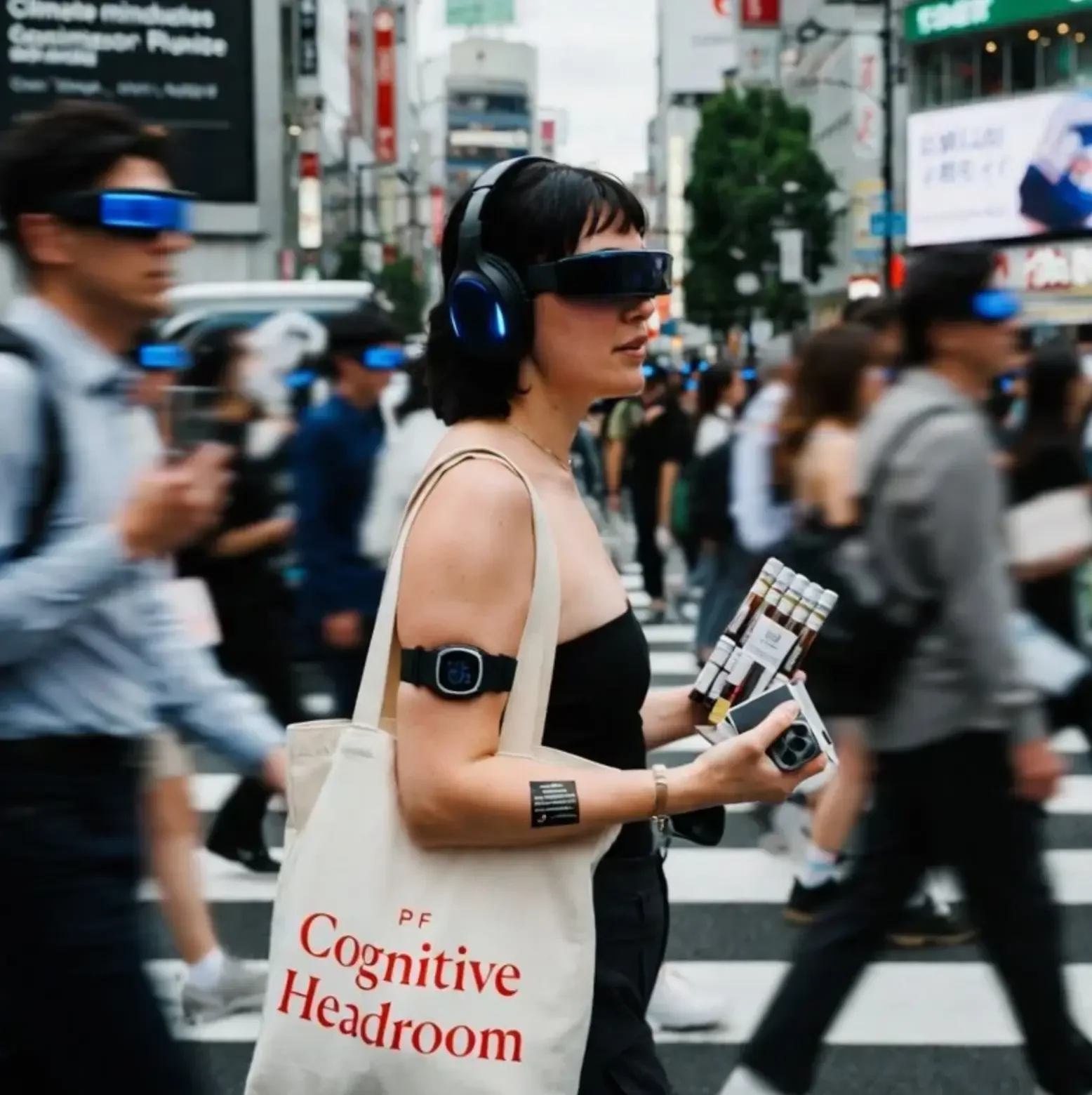
Abstract
Modernity is defined by a developmental discontinuity between the high-velocity systems we have built and the internal architecture through which we navigate them. This piece shifts attention from symbolic survival to the engineering of the Observer. It argues that the next threshold is neither a more capable artificial intelligence nor a more efficient economy, but the widespread cultivation of metacognitive flexibility: the capacity to update mental models in real time without collapsing into defensive certainty.
Section outline
"Between stimulus and response there is a space. In that space is our power to choose our response. In our response lies our growth and our freedom." - Viktor Frankl
"The purpose of life is to be defeated by greater and greater things." - Rainer Maria Rilke
"One does not become enlightened by imagining figures of light, but by making the darkness conscious." - Carl Gustav Jung
This journal is offered as a framework proposal, not a clinical protocol, a policy prescription, or an exhaustive account of human neuroscience. The scientific literature cited throughout is accurately represented to the best of the author's knowledge, but neuroscience is an active and often contested field, and some of the interpretive claims made here, particularly those concerning predictive processing, gamma-band oscillations, and the relationship between environmental design and conscious engagement, should be understood as one coherent reading of that literature rather than its settled conclusion.
The Hickson Endeavours framework concepts introduced in this journal, including The Observer, State Horizon, and Counter-Chemistry, are proprietary conceptual frameworks developed through observation and practice. They are proposed here as tools for thinking rather than peer-reviewed findings. The institutional design proposals across education, economics, community architecture, and the developmental lifespan are built on sound developmental principles, but they are proposals, not evidence-based guidelines, and they should be engaged accordingly.
This journal is not written as an attack on existing institutions, economic systems, or religious traditions. It is an attempt to name certain patterns in human development, neurobiological configuration, and collective organization, and to propose what might become possible if those patterns were understood more clearly and designed for more deliberately. If any part of it feels unsettling, that may be because the questions it raises, about who builds the cognitive capacity for genuine self-awareness and at what cost, tend to reach into layers of identity, history, and social assumption that rarely get named directly. The aim here is not to destabilize that weight, but to look at it plainly, and to ask what becomes possible once we do.
Series Note
This essay belongs to the same sequence as The Persistence Constraint [Part I], The ADHD-Immortality Paradox [Part II], and God as Vulnerability Compression and Social Technology [Part III]. The first piece established the foundational problem of persistence: how organized forms remain coherent under pressure without requiring perfection, and how both organisms and civilizations survive through the governed management of variation rather than its elimination. The second piece carried that pressure inward, examining what happens when a mind becomes capable of self-reference, temporal projection, attachment, and the foreknowledge of death. It argued that much of human behavior, and much of institutional life, becomes organized around the management of finitude itself. The third piece extended that analysis into the symbolic layer, proposing that God, across much of human history, functioned not as the origin of morality or consciousness, but as one of humanity's most enduring technologies for compressing vulnerability into forms that made uncertainty more livable, grief more containable, and collective life more stable.
The present volume moves from symbolic structure into developmental architecture. Its question is no longer gently how organisms persist, or how societies metabolize death-awareness, but what kinds of human beings contemporary civilization is actually producing, and what kinds it is structurally failing to produce. Its central claim is that the defining crisis of modernity is not fundamentally technological, economic, or informational. It is developmental. Human civilization has generated systems of extraordinary external sophistication while leaving the metacognitive infrastructure required to navigate those systems unevenly developed, chronically stressed, and institutionally unsupported.
This volume introduces the observer as the central developmental achievement around which a viable future society must organize itself: the capacity to watch the mind in motion, to distinguish the model from the world it models, to tolerate prediction error without collapsing into defensive certainty, and to remain capable of contribution under conditions of complexity, plurality, and uncertainty. Drawing from predictive processing theory, neurodevelopmental science, trauma research, dopaminergic salience regulation, double consciousness theory, and the Hickson Endeavours framework vocabulary, including State Horizon, counter chemistry, the probe, and the warrior-student-gardener configuration, this volume argues that the next major evolutionary pressure on human civilization is not intelligence alone, but the widespread development of metacognitive flexibility.
The Architecture of Becoming therefore proposes a developmental and institutional redesign organized around finitude literacy, calibrated friction, cognitive headroom, and the cultivation of environments capable of building the observer without breaking the organism required to carry it. Its concern is not utopia. It is configuration. What conditions reliably produce humans capable of remaining open without disintegrating, conscious without dissociating, individuated without severing themselves from contribution, and adaptive without losing coherence?
Abstract
This journal proposes a comprehensive framework for human development and societal redesign organized around a single principle: finitude literacy, the full, integrated understanding of human limitation, mortality, and biological circumstance as the foundation for meaningful contribution rather than the source of existential avoidance. Drawing on predictive processing theory, dopaminergic salience regulation, prefrontal cortex developmental science, the neurobiological basis of metacognition, W.E.B. Du Bois's framework of double consciousness, the concept of cognitive headroom as developed by Wood (2025), and the Hickson Endeavours proprietary framework vocabulary, including the observer, State Horizon, counter chemistry, and the warrior-student-gardener configuration, this journal argues that the gap between the civilization we are capable of producing and the one we are currently producing is not a gap in knowledge, resources, or technology. It is a gap in neurobiological configuration. Specifically, it concerns the uneven development of what this journal terms the observer: the metacognitive capacity to watch one's own mind in motion, to hold two perspectives simultaneously, to update the predictive model when it misfires, and to act from contribution rather than from threat. The journal proceeds from a foundational account of thought as a probing mechanism, the brain's forward-cast hypothesis about reality rather than a transparent window onto it, through an evolutionary gradient that explains how the probe became, for most people, the primary substance of experienced reality itself. It then proposes the developmental and institutional conditions required to build the observer at scale across the full human lifespan, across every institutional domain, within an economic system that preserves the generative energy of healthy capitalism while structurally incentivizing genuine contribution to collective wellbeing. The next iteration of the healthy human is a warrior, a student, and a gardener. This journal is the design specification for the conditions under which that person becomes possible.
I. The Organizing Principle: Finitude Literacy
Every significant institutional failure of contemporary civilization shares an underlying mechanism.
Not greed, exactly, though greed is a downstream symptom. Not ignorance, though ignorance accompanies it. The underlying mechanism is the systematic avoidance of finitude, the refusal at the individual and collective level to fully integrate the fact of limitation, mortality, and biological circumstance into the operating model of a human life.
Finitude literacy is the developed capacity to hold that integration without flinching. To know, in the felt sense rather than merely the intellectual one, that the lifespan is bounded, that the self is constructed, that the body will fail, that the civilization is temporary, and to organize one's energy accordingly. Not toward the management of that terror, but toward the contribution that becomes possible once the terror is no longer consuming the available cognitive reserve.
The cognitive reserve point is precise and worth establishing before proceeding. Wood (2025), in The Stimulated Mind, describes cognitive headroom as the brain's reserve capacity, not what the brain is currently using but what it has available when pressure mounts. The inputs that build genuine headroom, including sleep, movement, nutrient supply, social connection, and calibrated stress, are well documented. What is less often named is what consumes headroom invisibly from beneath perception: the metabolic cost of maintaining self-narratives that require active suppression of contradicting data, including, most expensively, the data of mortality itself.
A civilization organized around finitude avoidance is a civilization running an enormous background processing load. The resources that could be directed toward genuine contribution, genuine connection, and genuine creative output are being consumed by the maintenance of stories that cannot hold. The political tribalism, the extractive economics, the institutional rigidity, the personal emptiness underneath the correctly constructed life: these are not isolated failures. They are the outputs of a species spending most of its cognitive reserve on the management of a terror it was never taught to integrate.
Finitude literacy does not ask people to stop being afraid. It asks a different question. What becomes possible once the fear is no longer running in background? What does a society look like when enough of its members have integrated limitation rather than suppressed it, and organized their energy accordingly?
This journal is the attempt to answer that question with institutional specificity.
II. The Probe and the World: Thought as Modeling Tool
Before any developmental or institutional proposal can be meaningfully made, the foundational mechanism must be established with precision. The foundational mechanism is this: the brain does not receive the world. It models it.
This is not a philosophical claim about the ultimate nature of reality. It is a neurobiological description of how the human nervous system operates moment to moment.
The brain is, in its most fundamental operational character, a prediction engine. It generates forward-cast hypotheses about what the environment contains, what it means, and what should happen next. These hypotheses, what the neuroscientific literature calls the generative model, constitute the primary substance of experienced reality. The sensory data that arrives from the environment is not the experience. It is the correction signal. The model generated the prediction first. The senses report discrepancy. The gap is quietly closed before awareness registers that a gap existed.
What this means for the phenomenology of ordinary human life is stranger than it first appears.
A news headline arrives on a phone screen and the body responds before the article is opened. A colleague sends a short reply to a message and the interpretation, positive or threatening, is already formed before the context is considered. A face in a crowd is read as familiar or dangerous within milliseconds, long before any deliberate thought is engaged. None of these arrive as neutral information from outside. They are the model's output, shaped by every experience that preceded this moment, weighted by the emotional intensity with which those experiences were encoded, colored by the current biochemical state of the nervous system, and offered to awareness as simply the way things are. The probe does not announce itself as a probe. It arrives feeling like arrival.
This is by design. An organism that experienced its own predictions as predictions, that held every interpretation at deliberate arm's length and consciously interrogated the provenance of every thought before acting on it, would be paralyzed. The seamlessness of subjective experience, the sense that what I am perceiving is what is real, is not a malfunction of the system. It is the system working precisely as intended. The model has to feel like the world to function as a guide to action.
And yet the probe's self-concealment produces a condition of profound consequence.
When the thought arrives feeling like arrival, when the interpretation feels like the thing interpreted, the person experiencing it has no natural leverage point from which to ask: is this the world, or is this what my current state makes the world look like? The two feel identical from the inside. The anger at a perceived slight feels like accurate threat detection. The certainty born of exhaustion feels like visionary clarity. The diminishment that chronic scarcity produces in the quality of available thought feels like the permanent truth of one's own capacity.
The province of the corridor becomes the map of the whole territory.
Consciousness as Event
Here is an implication of the predictive processing framework that the field has not yet absorbed into common understanding, and that this journal takes seriously as a design principle.
If the brain defaults to automated prediction, running established models on low metabolic cost, and conscious engagement is triggered specifically by prediction error, by the gap between what was expected and what actually arrived, then consciousness is not a background state. It is an event. It keeps getting generated, moment to moment, by the friction between model and world.
Which means we are, in a precise sense, the friction between what we expected and what actually happened.
This is not a philosophical flourish. It has a specific and measurable implication. Research into gamma-band neural oscillations, the high-frequency synchronization patterns associated with focused, conscious processing, suggests that this kind of engaged, binding neural activity is metabolically expensive and does not run continuously. It is triggered by novelty, by the prediction errors that force the system to update rather than confirm (Fries, 2009; Lisman and Jensen, 2013). When the environment generates no significant prediction errors, when everything matches the model cleanly, this high-engagement processing is not required and the brain does not produce it.
The person moving through a perfectly predictable environment is not just bored. The conditions that generate conscious engagement are simply not being met. The autopilot handles everything. The model confirms itself. The pilot, to borrow a functional metaphor, stays off-duty.
This is the connection between environmental design and consciousness that most institutional thinking has not confronted directly. A society without sufficient genuine novelty, without the calibrated friction that generates clean prediction errors, is not merely unstimulating. It is, in a neurobiological sense, anesthetic. And the person moving through that environment does not experience its flatness as deprivation. They experience it as comfort. That is the most effective possible concealment of what is actually being lost.
The Evolutionary Gradient
This condition did not arise suddenly. It is the product of an evolutionary trajectory that can be traced with some precision, and that trajectory, what the Hickson Endeavours framework terms the gradient cosmology, illuminates both the depth of the problem and the direction of its resolution.
The earliest organisms operated with minimal buffer between environment and response. The gap between stimulus and experience was thin. The probe was short-range, crude, and corrected rapidly by immediate consequence. Error was expensive and visible. The organism that misread a predator's signal died. The correction mechanism was brutal and effective.
As the nervous system developed in sophistication across evolutionary time, the buffer between stimulus and experience thickened. The organism could predict further ahead, model more complex scenarios, run social simulations, and inhabit imagined futures and past events with enough fidelity to learn from them without experiencing them directly. The probe's range extended dramatically. The adaptive gains were extraordinary.
But as the buffer thickened, the relationship between the probe and the correction signal began to shift in ways that had no evolutionary precedent. The probe, now capable of generating scenarios of such richness and apparent reality that they could hold the nervous system's attention for extended periods, began to compete with actual sensory input for the status of primary experience. The range of the model's forward projection extended so far beyond the immediate environment that the correction signal, the actual sensory data arriving from the actual world, became a small voice in a very large room.
The thought became louder than the thing the thought was about.
In the modern human, operating inside dense social structures, abstract symbolic systems, prolonged temporal horizons, and media environments engineered to exploit the salience system's sensitivity to novelty and threat, this dynamic reaches its most extreme expression. The average person in 2026 spends more waking hours inside algorithmically curated information environments than in direct unmediated contact with their physical surroundings. The probe, trained against that environment, now constitutes the majority of experienced reality for most people in most moments. Not direct contact with the environment. Not the felt quality of the immediate present. The model's running output, interpreted as the world, lived as the sum of experience.
The buffer became the reading. The instrument began measuring itself.
This is the cosmological backstory of the institutional problem this journal proposes to address.
The Subjective Grip and Its Relaxation
The subjective grip, the felt sense that what I am experiencing is what is real, is not uniformly tight across all people in all states. It is modulated, in significant and measurable ways, by the biochemical condition of the nervous system running it.
Under chronic threat, the kind produced by poverty, structural marginalization, relational instability, or the persistent activation of the autonomic stress response, the grip tightens. The model narrows toward threat-relevant content. The salience network tags an increasingly restricted range of stimuli as important. The probe fires shorter, faster, more defensively. The corridor narrows.
This narrowing is not cognitive impairment in the pejorative sense. It is precise adaptive calibration. The nervous system under genuine threat correctly prioritizes threat detection over broad perceptual flexibility. The issue is not that the narrowing happens. The issue is that it persists long after the conditions that produced it have changed, that the open files of unprocessed threat experience continue consuming headroom and biasing the model long after the original threat has passed.
Under genuine autonomic regulation, not the performance of calm but the actual biochemical condition of a nervous system that is not running threat detection at elevated baseline, the grip loosens. Not the model itself, which continues generating, but the identification of the model's output as final truth. The probe begins to feel, faintly, like a probe. The narrative carries its own weight slightly more visibly. The subjective reading of the moment softens enough that the question becomes genuinely askable: is this the world, or is this what my current state makes the world look like?
This is not enlightenment. It is not liberation from subjectivity, which is not available to a biological organism and the suggestion of which does genuine harm to people who experience their own persistent subjectivity as spiritual failure. It is something more honest and more useful: the graduated relaxation of the grip that biochemical regulation, processed experience, and the development of the observer can produce across a lifetime of deliberate engagement with the actual conditions of being human.
The difference between a fist and an open hand around the same object.
The world does not change. The holding of it does.
Iron Sharpening Iron: The Metacognitive Probe, or “Thought”
The most sophisticated expression of the modeling mechanism, and the one most relevant to this journal's developmental argument, is the capacity to use one probe to interrogate another.
When the first thought arrives, shaped by the current biochemical state, the activated emotional history, and the salience system's current prioritization, it carries the full felt weight of apparent truth. Most people, most of the time, follow it. The thought feels like information. It feels like the world reporting in. And the behavior that follows treats it as such.
Consider a common 2026 experience: a notification arrives, a single line of text from someone in one's professional or personal life, and within seconds the nervous system has generated a complete narrative about the sender's intentions, the implications for the relationship, and what it means about one's own standing. That narrative is not information. It is the first probe, shaped by sleep quality, current stress load, relational history, and whatever biochemical state the body is running at that moment. It feels like reading the situation. It is the model predicting the situation.
The prefrontal cortex, when sufficiently resourced and when the observer has been developed through deliberate practice, can do something the rest of the system cannot. It can notice the thought as a product of modeling rather than as a transparent window onto the world, and it can launch a second probe to interrogate the first. What context is missing here? What is the actual evidence versus what the model has filled in? What state am I in right now, and how is that state shaping what I am reading into this?
This is what the neuroscientific literature identifies as metacognition, thinking about thinking, and it is the foundational capacity on which the observer and everything this journal subsequently proposes depends. The second probe does not produce certainty. It produces complexity where certainty had prematurely closed. It holds the corridor open long enough for the model to update rather than calcify.
This capacity, to catch the probe mid-flight, to notice the modeling happening, and to use that noticing as the ground from which a more accurate reading becomes possible, is not uniformly distributed. It is built through specific developmental conditions, specific neurobiological substrates, and specific environmental inputs that the reformed society this journal proposes is designed to provide at scale.
State Horizon: The Boundary of the Knowable
Before proceeding to developmental and institutional proposals, one framework concept requires formal introduction because it organizes much of what follows.
The State Horizon, a Hickson Endeavours proprietary framework concept, refers to the boundary of what is perceptible from within a given neurochemical state. The person operating within a particular configuration of cortisol, catecholamines, glucose availability, sleep debt, and autonomic activation can perceive and accurately assess only what falls within the horizon that configuration produces. Beyond that horizon, the probe cannot reach, not because the information does not exist, but because the current biochemical architecture cannot generate predictions accurate enough to detect it.
The State Horizon has a specific and clinically significant implication: a person cannot accurately perceive the limitations of their own current state from inside that state. The horizon is, by definition, the edge of the perceptible. What lies beyond it is not experienced as absence but simply as not existing.
This is why genuine biochemical state shifts, through sufficient sleep, through metabolic restoration, through the resolution of chronic threat conditions, can produce what subjectively feels like revelation. The person who wakes after genuine restorative sleep does not experience the same world they experienced the night before, not because the world changed but because the State Horizon expanded. What was previously beyond the horizon of perception is now perceptible. And the prior state, now visible by contrast, can be assessed with an accuracy that was not available from within it.
The evidence provisioning methodology, documenting the baseline, the intervention, and the variance between states, is the empirical infrastructure that makes State Horizon a clinical framework rather than a phenomenological observation. The systematic documentation of what is perceptible within a given state, what becomes perceptible after a documented state shift, and the measurable variance between them constitutes the body of evidence from which genuine developmental progress can be tracked.
This framework belongs at the foundation of any serious developmental science of the human being. It is proposed here as such.
III. The Container and the Tribe
With the mechanism established, the social expression of that mechanism becomes legible.
A grown adult who will fight a stranger over a sports team is not irrational in the pejorative sense of that word. They are running hardware that requires specific inputs to function, and the team is providing those inputs at full volume.
The nervous system is not optional about certain questions. Who am I. Who are my people. What is worth protecting. What threatens what I love. What happens when I die. These are not philosophical preferences. They are biological requirements. The salience network needs an organizing principle. The dopamine system needs something to score prediction errors against. The model needs edges, and without supplied edges it will manufacture them.
The first probe, fired into any ambiguous social environment, requires a landscape of prior predictions to work from: which categories are safe and which are dangerous, which people are us and which are them. Tribal identity provides this landscape with extraordinary efficiency. The sports team, the religious tradition, the political party, the nation: each of these provides a complete answer set to the nervous system's foundational questions simultaneously.
Community. Mortality management. Contribution framework. Shared ritual. Shared story. A coherent definition of the enemy of what one loves.
Religious tradition has been doing this work for the entirety of recorded human history with a sophistication that secular modernity has been systematically arrogant in dismissing. It provided containers for the terror that genuine self-awareness produces: the exposure of mortality, the possibility of meaninglessness, the vertigo of a self that cannot locate its own foundation. It provided the relational architecture of genuine community, not the frictionless kind, but the kind with shared obligation, shared practice, and shared ways of marking birth and loss and the passage of seasons. It provided the contribution framework: your existence has consequence beyond your own span, and that consequence is witnessed.
It also, in its institutional forms, has caused profound harm. Enforced certainty where inquiry was needed. Closed containers that survival required to remain open. The same mechanism of salience capture, identity fusion, and tribal coherence used to justify violence, suppression, and the concentration of power in the hands of those who controlled the narrative.
The problem was never the need the container was meeting. The problem was what particular containers required one to believe in order to stay inside them, and what they did to those who could not or would not believe it.
Sports tribalism, nationalism, political polarization: these are not different problems. They are the same mechanism wearing different jerseys. The fight over the team is real feeling doing borrowed work. The first probe fired by a nervous system in threat mode, looking for edges, grabbed the nearest available organizing principle and called it truth.
Freefall is genuinely frightening. The view from outside the model is not automatically liberating. It is exposure. Standing before the actual scale of things without a story to render them manageable. Before a single word is said about new containers, that must be acknowledged and held.
IV. The Friction
The zoom-out, the moment the mechanism becomes visible rather than merely inhabited, does not arrive by invitation. It comes through disruption, and the disruption is rarely comfortable.
The default state of being human is full immersion. Inside the model, living its outputs as reality, with no natural friction in that process that would produce the question: what is generating this? The system does not come with an outside. A well-calibrated salience network is efficient precisely because it is invisible to the person running it. The probe does not feel like a probe. It feels like Tuesday, and Tuesday feels like the world.
To arrive at the place where the mechanism becomes visible rather than merely inhabited, something must interrupt the immersion. The interruptions are rarely gentle.
Sometimes it is suffering the existing model cannot explain away, the loss that does not fit, the correctly constructed life that still produces hollowness. Sometimes it is radical encounter with genuine difference, a person or a place that the model has no category for and cannot quietly absorb. Sometimes it is sustained solitude. Sometimes it is a particular kind of loneliness that lasts long enough that one begins watching oneself have it.
However it arrives, the friction is not a reward. It is a disruption. The model failed loudly enough that the model became visible.
This matters because it removes the hierarchy that can too easily accumulate in conversations like this one. The person who is calm, embedded, and fully running the first game, who has mastered social calibration, emotional regulation within the model, and the construction of a life that generates enough predictive confirmation to remain functional and warm and connected, has done something genuinely difficult, even when it is invisible work. Most people who do it well have no idea they are doing it. That is part of what mastery looks like.
The friction that produces the zoom-out is an interruption, not a prize. What one does with it, whether it becomes detachment and private superiority or whether it is brought back into full contact with the people and the life around it, is the only question that matters after it arrives.
Staying lofted is its own trap. A more sophisticated one, decorated with better ideas. But the same fundamental dissociation wearing different clothes.
The Controlled Authority Figure as External PFC
There is a specific friction configuration worth naming with precision because it is more common than the literature acknowledges and because it illuminates the connection between individual developmental history and the broader civilizational argument this journal is building.
When a parent or early authority figure functions as an external prefrontal cortex, monitoring, judging, course-correcting, running the surveillance that the child's own developing brain has not yet grown to provide, the child's nervous system adapts with precision. It learns to run a continuous high-beta simulation: how will this be received, what is the likely response, where is the danger in this moment. Every word, gesture, and impulse filtered through a security checkpoint before it leaves the mouth. The prefrontal cortex develops, but it develops in the service of threat prediction rather than autonomous identity. It becomes a police officer rather than a director.
When that surveillance is removed, the rebound is neurologically predictable. The PFC, having been running at redline under constant monitoring, releases. And release, for a nervous system that only ever knew two states, total lockdown or total exposure, does not feel like freedom so much as it feels like the floor disappearing. The suppressed interior surfaces all at once. Boundaries become porous.
This is the pendulum. Total lockdown. Total exposure. No middle gear, because the middle was never available to practice.
The integration of that pendulum, the development of a regulated, consistent executive presence that stays functional whether the surveillance is present or not, is not a psychological achievement alone. It is a neurobiological one. The prefrontal cortex rebuilt not as enforcer but as director. Not policing the self into safety. Knowing the self well enough that safety is no longer the primary project.
V. The Observer
Here is what that friction, at its best, produces.
Not damage, though damage may accompany it. Not merely survival, though survival is required. The friction, when processed rather than simply endured, builds something that the uninterrupted immersive life does not naturally generate.
It builds the observer.
The observer is the capacity to watch one's own mind in motion. To feel an impulse arrive and pause before becoming it. To hold a reaction and ask whether it is a signal from the world or an echo of the model. To carry two perspectives simultaneously, the one living inside the experience and the one watching the experience happen, without either one collapsing into the other.
It is the capacity to catch the probe mid-flight.
This is not abstract. It is a physical achievement. The medial prefrontal cortex, the anterior cingulate cortex, the insular cortex: these structures, in their integration and their communication with the limbic system beneath them, constitute the neurological infrastructure of the observer. When they are developed and connected and running with the kind of white matter integrity that comes from years of processing difficult internal experience, the result is something qualitatively different from the stimulus-response configuration.
The stimulus arrives. The response is not automatic. In the space between them, in what Frankl (1946) called the most important space a human being can occupy, the observer lives.
Now consider who has been billed most consistently for the development of that space.
Du Bois, writing in 1903, described what he called double consciousness, the sense of always looking at oneself through the eyes of others, of measuring one's soul by the tape of a world that looks on in amused contempt and pity. He was describing the experience of being Black in America. He was also, with the precision of a man who lived it every day, describing the forced construction of the observer.
When the environment consistently reads your presence as threatening, your belonging as conditional, your behavior as requiring justification that others' behavior does not, the nervous system cannot afford pure immersion. It must run the dual track. The self living the moment and the self watching the moment from outside, monitoring how it is landing, adjusting in real time. This dual-track processing is metabolically expensive. It is socially exhausting. It extracts a cost that should never have been levied.
But it builds the second floor.
The person whose presence was never questioned, whose belonging was never conditional, whose behavior was never under structural scrutiny, whose model was confirmed so consistently by the environment that the model never had to become visible, did not need to build the observer. The environment never billed them for it.
This is not a moral indictment. It is a developmental description. The absence of that friction produced a genuine gap, not in intelligence, not in worth, but in a specific cognitive architecture that the friction, when survived and integrated, reliably generates.
And as the world becomes irreversibly plural, as the monocultures dissolve, as proximity between previously separate populations becomes unavoidable, a certain kind of person will find themselves increasingly disoriented without being able to name why. Not because they are malicious. Because they were never asked to hold two perspectives simultaneously. The world confirmed their model so reliably that the model never had to become visible to them.
And now the world is no longer doing that.
The person running a calcified categorization system in an increasingly plural environment is not running evil in the first instance. They are running a developmental arrest. A prefrontal cortex that was never asked to do this particular work, meeting a world that is now requiring exactly that work.
The selection pressure is real. It does not require enforcement or design. A world that demands the observer to navigate successfully will simply make the unconfigured model increasingly insufficient. The question is not how to accelerate that pressure. The question is how to design conditions under which enough people develop the observer before the pressure breaks them rather than builds them.
The Recursive Observer
There is a structural feature of the observer that the framework must acknowledge honestly rather than paper over.
If the prefrontal cortex is the observer watching the reactive hardware, something must notice the PFC noticing. There is no clean terminus to that chain. The observer is not a fixed throne from which a stable self surveys the machinery beneath it. It is a process, one that keeps regenerating itself at the edge of the expected, at the point where prediction meets discrepancy and the gap forces engagement. This is not a flaw in the framework. It is the most important design constraint in it.
An observer that stops encountering genuine surprise starts becoming the thing it was watching. The metacognitive habit that once felt like watching the mind at work becomes, over time, just another automated pattern, running on schedule, generating the familiar feeling of self-awareness without the actual contact with reality that gives self-awareness its corrective function. The observer calcifies. This is why the student orientation is not optional for the warrior or the gardener. It is the mechanism that prevents the observer from closing. The student keeps the model from treating its own operations as final. The student is the part of the configuration that insists on encountering the world as something that can still produce genuine surprise, that can still generate the prediction error that forces the system to update rather than confirm. A warrior without the student becomes a defender of a fixed position. A gardener without the student becomes a maintainer of an established garden. Only the student keeps both orientations honest, keeps the observer regenerating rather than settling, keeps the Glow, to borrow the neurobiological language, from fading into the automated baseline it was built to transcend.
VI. The Counter Chemistry
Friction is not the enemy. The configuration of friction is.
This distinction changes everything, and it is the one most systems currently get wrong.
Chronic stress, the kind produced by poverty, structural threat, housing insecurity, food scarcity, and persistent social danger, does specific and measurable things to the prefrontal cortex. It causes dendritic atrophy, a physical reduction in the branching complexity of PFC neurons (Arnsten, 2009). It floods prefrontal regions with catecholamines that suppress their function. It hypertrophies the amygdala. The brake weakens while the accelerator strengthens. This doesn't function as a metaphor, but as architecture.
A child raised inside conditions of chronic threat is not developing the observer. They are developing the survival scanner, a system optimized for detecting danger, not for watching the self in motion. The prefrontal cortex that emerges from that environment is not weak through lack of effort. It is precisely configured for the environment it actually had to survive. Which means that designing for human development is not about increasing friction. It is about replacing friction that breaks with friction that builds.
Friction that breaks exceeds the organism's capacity to process it without relational support. It produces dysregulation without resolution. It encodes threat without providing the safety necessary to integrate the experience. It keeps files open. Friction that builds is calibrated, just at or slightly below the organism's current capacity, with sufficient relational safety present that the encounter can be processed rather than merely endured. It produces prediction error the system can absorb and update from. It generates the observer. The difference between the two is not the intensity of the challenge. It is the presence of conditions that make processing possible. This is the oldest principle in developmental science. The organism grows at the calibrated edge, in conditions of sufficient safety. Not in the absence of challenge. Not in overwhelming threat. At the edge.
Every major system in contemporary life is, in one way or another, counter to what is being described here. Education systems that reward compliance over metacognition. Economic systems that reward output over integration. Urban design that optimizes for transaction over genuine contact. Social media architectures engineered specifically to keep the amygdala engaged, because a regulated prefrontal cortex is a less captive user. The entire infrastructure of modern life is, in aggregate, a friction configuration that generates the survival scanner. Changing that is the work. Not through revolution. Through redesign.
VII. Headroom and the Open File
There is a concept worth positioning precisely here because it bridges the mechanism and the design proposal. Wood (2025), in The Stimulated Mind, describes cognitive headroom as the brain's reserve capacity, not what the brain is currently using but what it has available when pressure mounts. The inputs that build headroom, including sleep, movement, nutrient supply, social connection, and calibrated stress, are well documented. The 3-S model Wood articulates, Stimulation, Supply, and Support, provides a practical framework for the inputs that maintain and expand this reserve. But headroom has a layer beneath the performance optimization framing that this journal's argument requires.Most of what occupies headroom is invisible to the person it belongs to. The processing happens below perception, beneath the threshold of what can be felt, named, or deliberately managed. The brain is running accounts the conscious mind never authorized and cannot directly audit. What drains the reserve is not only the visible demands of the day. It is the unresolved material running underneath them.
Processing as Neurochemical Completion
When a prediction error occurs and the conditions are safe enough to complete the neurochemical cycle, activation, contextualization, encoding, return to baseline, the cost is temporary. The file closes. The model updates. The system carries the experience forward as information. When the cycle cannot complete, because the arousal is too high, the relational safety too thin, or the available resources already depleted, the file stays open. The brain, being a completion machine, keeps attempting to resolve it. Quietly. Continuously. At a cost that accumulates without ever surfacing as a distinct sensation because it has become indistinguishable from baseline.
Processing is a specific neurochemical sequence, not a metaphor. The amygdala fires. Cortisol and norepinephrine shift the body into activation. If the conditions are safe enough, the prefrontal cortex comes online and begins contextualizing, locating the experience in time, in narrative, in relationship to what came before. Language engages. The left hemisphere begins labeling what the right hemisphere is feeling. Affect labeling alone, simply naming what is present, measurably reduces amygdala activation (Lieberman et al., 2007). The signal begins to move.
The hippocampus then performs the work of temporal encoding, placing the experience in the past rather than holding it in perpetual present. This is the distinction between a processed memory and an unprocessed one. Trauma, in significant part, is a failure of hippocampal temporal encoding. The event has no then. It keeps arriving as now. Successful encoding moves the experience from active threat to stored context. The model updates. The arousal state returns to baseline. Cortisol clears. The file closes. Headroom returns to the system. This completion is what processing actually is. Not talking about something. Not understanding it intellectually, though both may arrive alongside it. The full neurochemical cycle running from activation to resolution.
Over time, unresolved files compound. Each one slightly biases the predictive model, more defensively, more narrowly, more oriented toward threat. Which means the next similar signal gets filtered through a model already primed against it. Which increases the likelihood that the next error also fails to close. Which opens another file. The background processing load grows without the person experiencing it as discrete events. It simply becomes the quality of their tiredness. The reactivity that seems disproportionate to the present moment because it is, carrying the accumulated weight of everything that never completed its cycle.
Why the Conditions Matter More Than the Instruction
You cannot tell someone their foundational predictions are wrong. The model will receive that as a threat and close. The survival scanner does not distinguish between a dangerous challenge and an accurate one. It responds to the activation level, not the content. What actually moves the model is a clean prediction error. Small. Survivable. Held inside enough relational safety that the nervous system can stay online long enough to process it. When those conditions are present, the encounter generates a discrepancy the model has to absorb. The PFC stays engaged. Contextualization happens. The hippocampus places the experience in time. The file begins to close.
This is why genuine safety is not a comfort measure. It is a processing condition. The nervous system cannot complete cycles it cannot afford to open. And it cannot afford to open them in environments where the cost of exposure exceeds the available support. Building headroom at scale is therefore not primarily a biohacking project. It is not supplements or sleep optimization alone, though those inputs matter. It is the removal of the chronic conditions that generate open files faster than any individual can close them, and the construction of environments in which the closing can actually happen.
That is the deepest version of the design brief.
The Anesthesia of Comfort
The consciousness-as-event insight carries a design implication that the framework cannot afford to pass over quietly.
If conscious engagement is an event triggered by prediction error rather than a background state maintained continuously, then environments engineered to minimize prediction error are not just comfortable. They are anesthetic. Not in the melodramatic sense, but in the precise functional sense: they remove the trigger that summons the observer.
A person moving through a perfectly curated, algorithmically optimized environment, one in which every feed is tailored, every recommendation is accurate, every social interaction is frictionless, and every expectation is met, is moving through an environment that is systematically reducing the conditions under which conscious engagement is neurobiologically necessary. The autopilot handles everything. The model confirms itself. And crucially, the person does not experience this as deprivation. They experience it as ease. That is the concealment.
This is not an argument against comfort. It is an argument about what kind of friction a well-designed environment should preserve and what kind it should remove. The reformed society described in this journal is not a society that eliminates convenience. It is a society that distinguishes between friction that breaks, the chronic, unsupported, unprocessable kind that generates the survival scanner, and friction that builds, the calibrated, novel, supported kind that generates the observer and keeps the observer regenerating.
A society that removes the first and preserves the second is the design target. Not deprivation. Not engineered difficulty. Calibrated encounter with genuine novelty, built into the architecture of daily life, delivered inside conditions of sufficient safety that the encounter can be processed rather than merely survived.
The conscious life is not the comfortable life. It is the life lived at the edge of its own model.
VIII. New Meaning
What do we offer in place of the old containers?
Not replacement theology. Not secular humanism in ceremonial dress. Something more honest and more durable than either.
Meaning that can be verified by living it.
Contribution is the most stable form of meaning available to the human nervous system, not because it is virtuous, though it is, but because it is mechanistically self-sustaining. When one is genuinely oriented toward the reduction of another person's suffering, when that orientation is the organizing principle of daily attention, the salience network has a true north that does not require doctrine to maintain, does not need enemies to define itself against, and does not collapse when the institutional container shifts.
Every major contemplative tradition, underneath the accumulation of doctrine and institution, is pointing at this same orientation. Love, used carefully, is almost always pointing at a quality of attention before it is pointing at a feeling. The instruction to love one's neighbor is, in neurobiological terms, an instruction to include the neighbor's experience in the model. To allow their reality to become salient. To let what matters to them register as mattering.
That is the observer applied outward.
The new container keeps what religion and tradition got right: community organized around shared practice and shared purpose, not merely shared belief. Genuine mortality companionship, not denial or metaphysical promise, but honest presence with one another in the fact of finitude. The contribution framework that makes an individual life feel consequential beyond its own span.
What it does not require is the ceiling, the metaphysical enforcement mechanism that makes the container feel like the only alternative to meaninglessness.
You do not need cosmic oversight to act with integrity. You do not need an afterlife to care about the children born after you die. You do not need doctrine to find the practice of genuine attention to another person sustaining and worth organizing a life around.
These are not cold substitutes for warm belief. They are the warm belief, clarified. Made available to people for whom the old ceiling no longer holds, which is an increasing number of people in every tradition on every continent, without requiring them to discard the depth and the practice and the community the tradition also carried.
The invitation is not to abandon what one's tradition pointed at. It is to walk deeper into it until one reaches the layer that does not require the ceiling to remain true.
IX. The Architects
Here is what must be said plainly, and without apology.
The people who were billed most heavily for the observer, who developed it under structural duress, who built the second floor in the dark with no blueprint, under conditions that should never have been the price of self-knowledge, did not merely survive those conditions.
They quietly became the architects of what comes next.
Because they already know what the second floor looks like. They have lived in it. They built it under the worst possible construction conditions, under surveillance, under threat, under the weight of a world that required them to hold two perspectives simultaneously as a condition of basic safety.
Not superior in worth. Differently equipped. Specifically equipped for exactly the demands the world is now beginning to make of everyone.
The world is not becoming more dangerous. It is becoming more complex. And complexity, unlike danger, cannot be managed by the survival scanner. It requires the observer. It requires the second floor.
But here is the weight that must not be softened.
The architects of what comes next have been doing the hardest version of this work simultaneously. Not after the conditions improved. While the monoconscious model still leads, still forms institutions, still sets the terms of the environments through which the double conscious must move every single day.
Staying regulated while the systems surrounding you were built in dysregulation, for a different nervous system, with a different model of the human in mind, is a level of biological discipline that does not get named clearly enough. It is the daily choice to keep the observer functional when everything around you is designed to trigger the scanner.
The IF is real.
If the double conscious can stay regulated through the dysregulation of the systems that surround them. If the observer can remain functional under the chronic friction of navigating institutions not designed to see it. If the architects can keep building with everyone in mind even when everyone has not returned the consideration.
That IF is the most important variable in the entire equation. And it is the one that requires the most from the people who have already given the most.
Which is precisely why the design work that follows is not optional and is not slow.
X. The Developmental Lifespan: A Neurobiologically Grounded Architecture
Early Childhood: Ages Zero to Seven. The Substrate Years.
The first seven years of human life are the most neurobiologically significant period in the entire lifespan and the most institutionally neglected.
During this window the predictive model is being built from scratch. The salience network is being calibrated for the first time. The amygdala is encoding its foundational threat assessments. The prefrontal cortex is establishing the earliest architecture of executive function. The hippocampus is building the temporal scaffolding on which all future self-narrative will be organized. Whatever enters this window gets encoded at maximum depth, with maximum generalization, against the least mature processing infrastructure the person will ever have.
The primary developmental environment for children aged zero to seven is not a school. It is a relational ecosystem, a stable, warm, genuinely connected web of caregivers, extended family, and community that provides the predictability required for secure attachment, the calibrated novelty required for healthy salience development, and the relational safety required for the neurochemical cycles of processing to complete.
Secure attachment, established through consistent, attuned caregiving, is not a psychological nicety. It is the physiological foundation of PFC development (Siegel, 2012). The child who can predict the caregiver's availability and responsiveness develops a nervous system with lower baseline cortisol, higher PFC connectivity, and greater capacity for cognitive flexibility. The child whose caregiver is unpredictable, threatening, or absent develops a system calibrated for threat detection and survival, a configuration that is adaptive in the original environment and limiting in every other.
The reformed early childhood environment provides universal caregiver support infrastructure, community caregiving ecosystems that rebuild the extended network the nuclear family cannot supply alone, calibrated novelty as developmental curriculum, and consistent affect labeling as a primary parenting practice. The naming of what the child is experiencing measurably reduces amygdala activation and supports PFC development from the earliest months.
Middle Childhood: Ages Eight to Twelve. The Identity Range Years.
The second developmental phase has a specific task: the construction of identity range, the experiential discovery that the self can inhabit multiple expressions, environments, and relational configurations and return intact.
This is the neurobiological prerequisite for the observer. A child who has only ever been one version of themselves has no experiential basis for the understanding that the self is constructed rather than given. The model has never been destabilized enough to become visible.
The reformed educational environment for this age range is organized around genuine encounter with difference as a primary curricular objective, children working alongside peers from genuinely different backgrounds on projects that require genuine collaboration. The friction is real. The relational challenge is real. And the adult infrastructure is present throughout to support the processing.
Metacognition is introduced as a formal subject during this period. Not as abstract philosophy but as practical tool. When am I thinking clearly and when is something running underneath the thinking? What does it feel like when I am in threat response versus when I am genuinely curious? These distinctions, introduced with age-appropriate language and consistent practice, begin the construction of the observer's infrastructure.
The probe is introduced to children in accessible language as a probe. The idea that the first thought is the brain's best current guess rather than the final word on reality is not beyond the developmental capacity of an eight-year-old. It is simply never offered.
Adolescence: Ages Thirteen to Eighteen. The Horizon Testing Years.
Adolescence is neurobiologically the most volatile and consequential developmental period outside of early childhood. The prefrontal cortex is undergoing its most significant reorganization since infancy. Myelination is proceeding with use-dependent pruning shaping the permanent architecture of the adult brain. The dopamine system is at its most sensitive to social reward and threat simultaneously.
What the adolescent brain is doing is testing its horizon. Seeking the edges of the model. Generating prediction errors deliberately, through risk-taking, identity experimentation, and social transgression, in an attempt to calibrate the self against the actual world rather than the predicted version.
This is not pathology. It is the developmental mechanism by which the adult self is constructed.
The reformed society meets this mechanism with design rather than suppression. Genuine risk with genuine consequence. Mentorship as structural feature, every adolescent with consistent access to non-parental adults who have navigated the terrain ahead and can provide honest testimony. Identity laboratory as curriculum, the explicit support of identity experimentation as a primary developmental activity.
Finitude literacy is introduced at this stage. This is the age at which the reformed curriculum introduces mortality as a subject of serious inquiry, not morbidly, but with the full intellectual and emotional seriousness the subject deserves. The adolescent nervous system, already constructing meaning structures, is precisely positioned to begin this integration. The reformed curriculum does not leave it to chance or to grief.
Early Adulthood: Ages Nineteen to Twenty-Six. The Contribution Entry Years.
The reformed society organizes this period around genuine contribution entry, direct participation in the work of community maintenance, civic function, creative production, and caregiving that constitutes the actual infrastructure of collective life. Learning, mentorship, and formal education are woven around contribution rather than preceding it.
The contribution portfolio, a documented history of genuine contribution to collective wellbeing maintained, verified, and publicly accessible, is the primary credential that opens economic opportunity in the reformed system. Formal expertise still matters, but alongside demonstrated contribution rather than in isolation from it.
Adulthood: Ages Twenty-Seven to Fifty-Five. The Full Contribution Years.
The adult period is characterized by the full expression of the observer in motion, the warrior, student, and gardener operating simultaneously in the context of genuine contribution within a healthy capitalist economy that rewards that contribution materially.
In the reformed institutional environment, metacognitive capacity, the observer, is a recognized and compensated professional competency across every sector. Midlife is a recognized developmental transition with dedicated institutional support, structured reflection processes, contribution redirection opportunities, and peer community organized around the specific work of model revision at this stage of life.
Elder Adulthood: Ages Fifty-Six and Beyond. The Transmission Years.
The elder who has genuinely processed the experiences of a full life possesses something that cannot be credentialed, replicated, or accelerated: processed experience. The neurobiological output of decades of prediction errors that closed, of open files that eventually resolved, of a self-concept revised multiple times and remaining coherent through the revision.
The reformed society builds elder contribution into institutional structure at every level. Not as honorary roles but as functional developmental infrastructure. Elders embedded in early childhood environments providing extended family presence. Elders in adolescent mentorship networks providing honest testimony. Elders in adult workplaces providing the long-horizon perspective that short-term incentive structures systematically suppress.
The elder council as civic function serves as the institutional memory of the community, providing counterweight to the short-term prediction errors that dominate democratic decision-making.
Finitude literacy transmission is the primary elder contribution: the honest testimony of what a finite life actually looks like from close to its end. Not as warning or instruction, but as testimony. The reformed society builds formal structures for this transmission because it is the most powerful finitude literacy resource available, and it disappears with the people who carry it unless structures are built to receive and transmit it.
XI. Educational Architecture
The Core Principle
The reformed educational system has one organizing objective that supersedes all others: the development of the observer.
The metacognitive curriculum runs as a continuous thread across the full educational lifespan, with age-appropriate content and practice at each stage. In early childhood, it is as simple as naming what is happening inside. In middle childhood, it is the introduction of the distinction between thinking and the observation of thinking, the probe and the watcher of the probe. In adolescence, it is the application of metacognitive awareness to identity, belief, and the inherited model. In adulthood, it is the ongoing practice of updating the model in response to evidence.
The metacognitive curriculum does not require exotic pedagogical technology. It requires teachers who have done this work themselves. Educator development in the reformed system is organized around the teacher's own observer development as the primary prerequisite for entering the classroom.
Assessment Reform
The reformed assessment system uses longitudinal developmental portfolios, documented evidence of growth in cognitive flexibility, metacognitive awareness, contribution quality, identity range, and the capacity to navigate genuine difference, alongside standardized measures of foundational literacy and numeracy.
The contribution portfolio begins its construction in the educational years. Every genuine contribution a student makes to their community is documented, verified, and entered into the permanent contribution record that follows them through adulthood.
XII. The Contribution Economy
Healthy Capitalism Recalibrated
The reformed economic system is not post-capitalist. The generative energy of market competition, the drive to build, create, innovate, and accumulate, is not a bug in human economic organization. It is a feature that, properly channeled, produces exactly the kind of prediction-error-driven development that the observer requires.
What the reformed economy restructures is the incentive architecture that currently makes extraction more rational than contribution.
The Contribution Certification System
Every economic activity is evaluated not only for its market return but for its contribution index, a measure of its net effect on collective wellbeing, environmental sustainability, and the development of human capacity in the communities it touches. This index generates tangible economic returns through contribution premium pricing, contribution tax incentives tied to verified outcomes, and dedicated capital markets for contribution-certified enterprises.
The Meaning Dividend
The reformed economic system makes explicit what the existing system treats as externality: the economic value of meaning.
A workforce running high levels of existential background processing, the metabolic cost of finitude avoidance, unresolved identity conflict, and the dissociation between daily activity and genuine contribution, is a workforce operating well below its productive potential. The headroom consumed by that background load is headroom unavailable for the creative, collaborative, and adaptive work that generates genuine economic value.
The meaning dividend is the measurable productivity gain that accrues when that background load is reduced. Enterprises that provide genuine meaning through contribution-aligned work, genuine community, and economic reward proportional to value created generate human capital returns that justify the investment required to provide those conditions.
This is not idealism dressed in economic language. It is the honest accounting of what the existing system treats as externality.
XIII. Community and Neighborhood Design
The reformed community is designed from the ground up to build the observer in the people who move through it. Not through instruction. Through the physical and relational architecture of daily life.
Genuine density of difference is the structural condition for the developmental friction that builds identity range and the observer. Homogeneous communities are, in neurobiological terms, model-confirming environments. They prevent the prediction errors that update the salience network. They are, in the precise sense this journal has been developing, anesthetic.
Relational infrastructure consists of physical spaces designed not for transaction but for genuine encounter, places where people of different ages, backgrounds, and life stages naturally spend time together in activities that require genuine interaction.
Processing infrastructure means spaces specifically designed for the release of social pressure, environments where the rules of performance and presentation that govern most social interaction are suspended, where genuine expression is normalized, and where the nervous system can release its grip on the presenting self long enough for open files to begin closing. These spaces are neurobiological processing infrastructure as much as they are community amenity.
Natural consequence architecture accepts managed risk as a design principle, building physical and social environments in which genuine consequence is present alongside genuine support for processing it. Over-managed environments that eliminate consequence in the name of safety eliminate the prediction errors that produce development. They produce comfort. They produce the anesthetic.
The reformed community is not designed to be difficult. It is designed to be genuinely alive. That is a different thing entirely.
XIV. Finitude Literacy as Civic Curriculum
The Mortality Container Rebuilt
Every human civilization that has lasted has built a mortality container, a shared story, practice, or ritual architecture that makes the fact of death not only bearable but generative. The container does not need to be metaphysically true. It needs to be functional. It needs to take the terror that finitude produces and transform it into clarifying urgency.
The reformed society rebuilds this container on honest ground, not through the reintroduction of supernatural narrative, which an increasing number of people can no longer hold without the cognitive dissonance consuming the headroom the container was supposed to free, but through the construction of secular finitude practices that serve the same neurobiological function with greater epistemic honesty.
Community mortality rituals, shared public acknowledgment of loss as a community event, formal educational inquiry into mortality beginning in adolescence, and elder testimony as finitude transmission: these structures do not require supernatural sanction. They require only the honest acknowledgment that mortality is the universal condition that makes genuine connection possible.
Contribution as Response to Finitude
The central argument of finitude literacy is this: the integration of death, the full, felt acknowledgment of limitation rather than its ongoing suppression, produces a specific orientation toward the remaining time that is the most reliable source of genuine contribution available to a human being. The person who has genuinely integrated their mortality is not depressed or passive. They are freed. Freed from the background processing load of mortality avoidance. Freed to attend, fully, to what is actually present, the person in front of them, the work in their hands, the community they can genuinely affect, because the terror that was consuming their headroom has resolved into clarity.
That clarity is the contribution engine.
XV. The Warrior, Student, Gardener Society
The warrior, the student, and the gardener are not roles assigned to individuals or life stages. They are simultaneous orientations that the fully developed human being maintains across every domain of activity, and that the reformed society cultivates in every person across the full developmental lifespan.
The warrior protects the conditions. Not reactively. Not emotionally. When the far-frictioned arrive in threat mode, and they will, because the survival scanner does not immediately recognize safety as safety, the warrior meets that energy from a place so regulated the encounter does not escalate. The heat meets something that does not reflect heat back. Calm, clear, unemotional. Not because the warrior does not feel. Because the warrior does not need the situation to be different in order to function inside it. The gardener maintains what has been built. Tends the immediate, the neighborhood, the relationship, the small consistent acts that keep the ground fertile. Not heroic. Present and steady. The peace of daily life made into a practice. The student keeps curiosity alive. The model that never fully closes. The person who wakes up still interested in what they do not yet understand. Still updating. Still available to be surprised by the world and by themselves. The student is not decorative. As the recursive observer section established, the observer regenerates at the edge of genuine surprise. Without the student orientation, the warrior becomes a defender of a fixed position and the gardener becomes a maintainer of an established form. Only the student keeps both orientations honest. Only the student keeps the observer from calcifying into the automated pattern it was built to interrupt.
Together these three make a whole human being. And more importantly, together they make a functioning society. Every healthy community needs all three operating simultaneously.
XVI. Becoming
This is not a vision of a perfected species. It is this. Exactly this. Full presence on the rock. Full understanding of the mechanism. Full contact with the people in front of you, without the static of a model that needs defending. The observer in the seat. The probe seen as probe. The grip loosened. Oriented outward. Contributing. Warm.
The dissociation, the gap between what we know and what we can feel as present, between the future we can describe and the one we can act toward, between the stranger's suffering and the salience signal that would move us, has always been the enemy. Not ignorance. Not malice. The gap. Genuinely healthy conditions are themselves the measure of what we have built. Not a gauntlet. Not a punishment. Just actual health, real safety, real nourishment, real developmental friction, real community. And the person who has done none of the internal work will find that health unfamiliar rather than nourishing. Not because the conditions are hostile, but because the conditions are new. The nervous system was calibrated for dysregulation. Some will adapt readily. Others will need time and the patient company of people who have already learned to breathe there.
Close the gap. Not all at once. Not in a single generation. Just enough, in enough people, that the aggregate output of human attention and action begins to shift what is possible in the communities through which those people move. Begin in the neighborhood. Begin in the body, fed, rested, moved, connected enough that the hardware can run cleanly. Begin in the quality of attention brought to the actual person present, rather than the predicted version the model assembled in advance. Build schools where children learn to watch their own thinking. Build neighborhoods where the encounter with genuine difference is survivable and supported. Build economies where contribution compounds. Build institutions that design for the observer. Build elder infrastructure that transmits processed experience before it is lost. Build the finitude practices that make mortality a clarifying truth rather than a suppressed terror.
This is not idealism. It is physiology, applied with institutional precision, at the scale the moment requires. We are not waiting for better people. We are building the conditions under which the people who already exist can finally become who they were going to be anyway. The architects already know the way. They have always known. What remains is the building, patient, clear-eyed, wide enough in its design that when the rest arrive, there is already room. That is what becoming means. Not transformation into something other than human, however, the full arrival at being human. Here. On the rock. Altogether.
The arc has reached its structural conclusion. The Persistence Constraint established the mechanics of how any form remains itself under pressure. The ADHD-Immortality Paradox turned that pressure inward, examining the psychic weight of a self that can foresee its own ending. God as Vulnerability Compression tracked those pressures as they hardened into the symbolic armor of deity and doctrine. Now, The Architecture of Becoming follows the line to its final realization: moving beyond the defense of the vulnerable mind to the deliberate design of its successor. What began as a study of survival has become a blueprint for a society built to house the Observer, transforming the burden of finitude into the foundation of a new institutional reality.
References
Arnsten, A.F.T. (2009). Stress signalling pathways that impair prefrontal cortex structure and function. Nature Reviews Neuroscience, 10(6), 410-422.
Bowlby, J. (1969). Attachment and Loss, Volume I: Attachment. Basic Books.
Bronfenbrenner, U. (1979). The Ecology of Human Development. Harvard University Press.
Clark, A., and Friston, K. (2019). Whatever next? Predictive brains, situated agents, and the future of cognitive science. Behavioral and Brain Sciences, 36(3), 181-204.
Du Bois, W.E.B. (1903). The Souls of Black Folk. A.C. McClurg and Co.
Frankl, V.E. (1946). Man's Search for Meaning. Beacon Press.
Fries, P. (2009). Neuronal gamma-band synchronization as a fundamental process in cortical computation. Annual Review of Neuroscience, 32, 209-224.
Kapur, S. (2003). Psychosis as a state of aberrant salience: A framework linking biology, phenomenology, and pharmacology in schizophrenia. American Journal of Psychiatry, 160(1), 13-23.
Lieberman, M.D., Eisenberger, N.I., Crockett, M.J., Tom, S.M., Pfeifer, J.H., and Way, B.M. (2007). Putting feelings into words: Affect labeling disrupts amygdala activity in response to affective stimuli. Psychological Science, 18(5), 421-428.
Lisman, J., and Jensen, O. (2013). The theta-gamma neural code. Neuron, 77(6), 1002-1016.
McEwen, B.S. (2008). Central effects of stress hormones in health and disease: Understanding the protective and damaging effects of stress and stress mediators. European Journal of Pharmacology, 583(2-3), 174-185.
Neal, J.W., and Edelstein, M. (2023). For Black men, being tall increases threat stereotyping and police stops. Proceedings of the National Academy of Sciences, 120(21).
Porges, S.W. (2011). The Polyvagal Theory: Neurophysiological Foundations of Emotions, Attachment, Communication, and Self-Regulation. W.W. Norton and Company.
Siegel, D.J. (2012). The Developing Mind: How Relationships and the Brain Interact to Shape Who We Are, 2nd ed. Guilford Press.
Tottenham, N., and Galvan, A. (2016). Stress and the adolescent brain: Amygdala-prefrontal cortex circuitry and ventral striatum as developmental targets. Neuroscience and Biobehavioral Reviews, 70, 217-227.
Wood, T. (2025). The Stimulated Mind.
Yalom, I.D. (1980). Existential Psychotherapy. Basic Books.
Medical Disclaimer: This information is for general educational purposes only and does not provide medical advice, diagnosis, or treatment. Always seek the advice of a physician or other qualified health provider with any questions you may have regarding a medical condition.
Jay Lee is the founder of Hickson Endeavours, a behavioral intelligence holding company operating across elite sport, behavioral health, organizational consulting, public sector systems, and residential and community development. He writes at The Warm Direction.