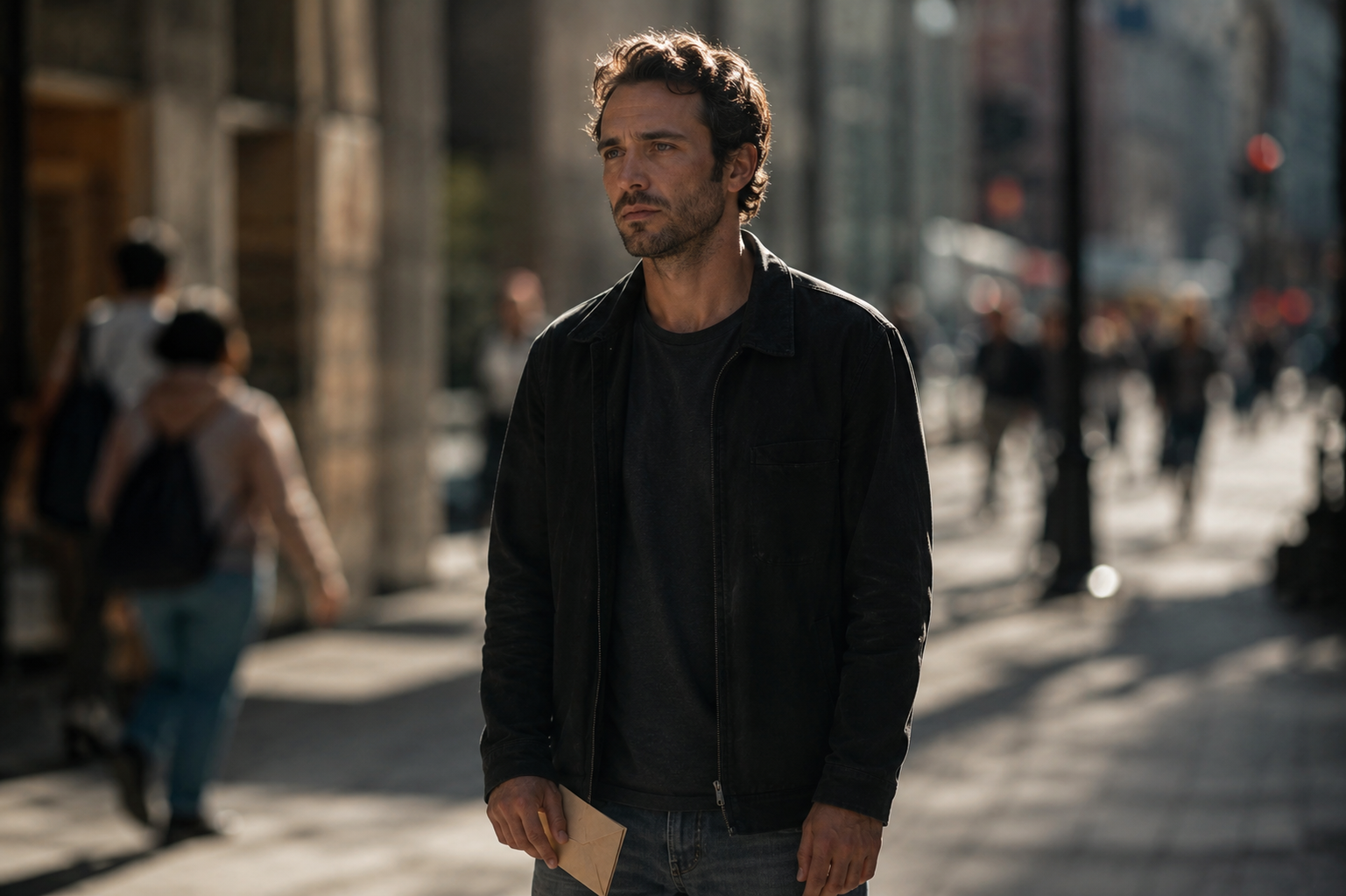
Abstract
Modern life is often praised for its efficiency, its comfort, and its ability to keep a man technically functional while quietly dissolving the conditions that made him feel alive. On the Rock traces that dissolution with dark humor and a straight face, following a mid-thirties everyman whose polished routine and perfectly respectable life slowly reveal themselves as a beautifully organized form of disconnection.
Section outline
Full Screenplay Treatment, Original
This script is offered as a narrative framework of individuation (or the process of), not a clinical protocol, a policy brief, or a solemn declaration that we have finally solved the human condition before lunch. The ideas explored here are drawn from a particular dramatic reading of grief, dissociation, family life, and meaning-making, and should be taken as story logic first and theological certainty, scientific consensus, or common sense second. The conceptual language in this script is used intentionally and with a straight enough face to get the job done. It is meant as a creative device, not as peer-reviewed doctrine, and if it occasionally sounds like someone spent a little too long thinking under fluorescent lights, that is because someone absolutely did. This script is not trying to pick a fight with family, faith, marriage, work, or the respectable architecture of normal life. It is simply pointing at the cracks in the drywall and asking, with maybe a touch too much confidence, whether the house was ever as solid as everyone agreed to pretend. If that question lands a little uncomfortably, that is usually how questions behave when they have been avoided for a while.
The aim here is not to insult what gives people comfort, purpose, or continuity. It is to notice what happens when comfort starts dressing like meaning, when routine starts calling itself a life, and when everybody in the room agrees not to mention the thing humming in the corner. This script is, at heart, an attempt to ask whether the joke was ever on the person who noticed first, or on everyone else for waiting so long to look.
Before The Film Begins
The Voice A Character Note He sounds like the kind of man who has a porch. Not because he is poor. Because he understands what porches are for. He has sat in enough stillness to know that the truth does not arrive in a hurry, and that a man who speaks before the thought is fully ripe is just making noise with confidence, which is most of what passes for conversation these days.
He is funny. Not performing funny. Actually funny. The kind of funny that comes from a man who has watched the world long enough to find it genuinely, tragically, lovingly absurd. His jokes land slow, the way a good biscuit hits, you don't notice it happened until it's already in you.
He is also one of the smartest people who has ever held a microphone. He just doesn't need you to know that. He already knows it. That's enough.
His cadence has red clay in it. Has Sunday morning in it. Has the particular patience of a man raised around people who did not waste words because words cost something where they came from. He is not angry. He was, once. He did the work. Now he is just, clear.
And clear, in a world like this one, is the loneliest thing a person can be.
He knows that too.
He is never seen. He has no name in the credits. Listed only as THE VOICE.
Cold Open
A Regular Morning No music.
A residential street, mid-morning. Quiet neighborhood. Sprinklers running. Someone's trash bins left at the curb a day too long. A woman walking a dog on a retractable leash, looking at her phone while the dog investigates a bush. A man backing out of his driveway, radio audible for a moment before he pulls away. The camera holds on all of this for too long. Long enough that the audience begins to look for something to happen. Nothing happens.
That is the point.
"Did you know..."
He lets that sit.
"...that most of what you are, was decided, before anybody asked you?"
"Now. Before you go thinkin' this is gonna be one of them films where somebody's real sad and everybody learns a lesson and you leave feelin' like you did something good for the world just by watchin' it."
"I want you to go 'head and let that expectation loose. Like a screen door in a strong wind. Just, let it go." "What I am about to tell you is true. And I know that's what everybody says. But I mean true in the way that the ground is true. Not the way a promise is true. The ground don't ask you whether you believe in it before it holds you up." "We are on a rock."
"A spinning rock. In the middle of, and I want you to really hear me now, absolutely nothing. For distances so large that the numbers don't fit in a human mouth. We are just, out here. Spinning. At about a thousand miles an hour, give or take. On a Tuesday."
"Nobody panicking."
"Doug next door is worried about his gutters." "Three hundred thousand years ago, roughly this morning, on the cosmic calendar, something that used to be considerably simpler... became us. Became the kind of thing that could feel lonesome on a crowded street. That could look up at the same stars its ancestors looked up at and feel, without being able to say why exactly, like it forgot something important." "That feeling has a name now. I'll get to it." "But first, I want to tell you about somebody. Regular as a Tuesday. Regular as gutters. Did everything the way it was shown to him, because that is what you do when the people showing you are the only world you got."
"Sports. School. A job. A good woman. A dog or two. Some groceries. A vacation in the summer if the Lord willin' and the creek don't rise."
"Then one day, the world got real quiet. And in that quiet, he heard something."
"And hearin' it, "
", cost him everything."
From off screen. A single gunshot.
Cut to black.
The Film Rewinds. Frames Run Backward. A Date Appears At Center Screen. Two Years Earlier Prologue
On The Species Footage of Earth from above. Ancient. Vast.
"Let me back all the way up. Because I think we owe ourselves the full picture."
"In the beginning, and I mean the actual beginning, not the one with the garden, though I understand why we needed that story, I genuinely do, we will get to that, in the actual beginning, there was nothing."
"Not dark. Not cold. Not empty."
"Nothing."
"And then, for reasons that even the best physics we got can only describe and not explain, something." "And that something expanded. And cooled. And formed. And over an amount of time that the word 'long' cannot begin to carry, stars, and rocks, and one particular rock, at just the right distance from just the right fire, and eventually, on that rock, something so small you couldn't see it decided to become more than it was."
"And it did."
"Over and over and over again. For billions of years. Just, becoming. A little more. A little more complex. A little more aware."
"Until one day, something stood up."
"Looked around."
"And the first thing it felt, "
", was probably hungry."
"Which is relatable."
Act One
The Shape of a Good Life
The Character
We never learn his name. The credits will list him only as HIM. This is intentional. He is everyone who has ever done everything right and still felt the low, persistent hum of something being wrong.
He is mid-thirties. Warm face. The kind of person strangers feel comfortable asking for directions. He laughs easily. He helps without being asked. He has two dogs, a larger mixed breed named Cass and a smaller one named Fig, and the way he talks to them, when no one is watching, tells you more about who he is than anything else in his life.
He has a spouse. Good person. They met in their mid-twenties at something ordinary, a friend's birthday, a work event, and built a life the way their parents showed them to. Steady. Predictable. Warm enough, most of the time.
He has a job. It involves a screen and a chair and meetings that could have been emails. He is good at it. He does not love it. He has not yet been asked to examine the distance between those two things.
His family lives nearby. Mother, siblings, cousins, aunts, the whole architecture of origin, within driving distance. They gather on Sundays. His mother sends him articles that remind her of him, always slightly off, always from three years ago, always forwarded with a single heart emoji. He responds with a heart emoji. This is love, at the resolution they both have access to.
The Texture Of His Days
The film takes its time here. This section is almost meditative. The audience needs to understand that this is not a bad life. That is essential. The film is not making a case against comfort. It is making a case against comfort that has been mistaken for meaning.
Morning. He wakes before the alarm because Cass has put her chin on his knee. Coffee made exactly the way he likes it, he has strong opinions about this. His spouse makes it different and he has learned not to say anything.
Eight hours of opening and closing things on a screen. Two calls. Notes typed into a document he will never read again. Lunch eaten at the kitchen counter while scrolling through something he won't remember finishing.
Evening. He walks the dogs. Fig investigates the same mailbox with the same urgency as if it is the first time, every single day. He finds this genuinely funny. He tells his spouse about it when he gets home. She smiles. The smile is real but brief. She is looking at her phone.
Dinner. A TikTok recipe. Sleep. Repeat.
This loop is shown across four minutes of screen time. No commentary. By minute three the audience begins to feel something. Not boredom. Something closer to recognition. Something closer to dread.
"Here is what we decided work would mean. You will give the best hours of your best days to something that is not yours. In exchange, you will receive enough to build a life around the edges of those hours. And that life, the evenings, the weekends, the two weeks a year of vacation, that is where you will try to fit everything that actually makes you a person." "And most people do it. Most people do it their entire lives and find real meaning inside it."
"I am not here to take that from anyone."
"I am only here to ask: did you choose it? Or did it choose you, by being the only option visible from where you were standing?" "Because there is a difference. And the body knows the difference, even when the mind has been convinced otherwise. The body keeps a ledger. It always has. And one day, sometimes quietly, sometimes not, it presents the bill."
The First Hairline Fracture
It appears at a Sunday gathering. Family. Loud, warm, food on every surface, a football game making noise in the background that only two people are actually watching.
His cousin says something casually cruel about a mutual friend going through a divorce. Something like, "Well what did she expect? You don't just change who you are and think people are gonna follow you around." Everyone laughs, or moves on, or nods.
He doesn't laugh. He doesn't say anything either. The camera catches his face for just a moment. A single frame where something behind his eyes is doing the math on a question he hasn't yet formed into language. Then his mother hands him a plate and asks if he wants more. He says yes. And it's gone.
The audience caught it. No one in the room did. "Nobody asked you what you wanted to care about. They just handed you a ball. Or a book. Or a church pew. Or a particular neighborhood with a particular set of expectations. And you were good at it, or you weren't, but either way you understood very quickly what you were supposed to want to be good at." "And here is the part we never talk about: that is not a failure of parenting. That is parenting. That is what we have always done, handed the next one what we were handed, with a little polish on it, a little of our own hope pressed into the corners." "The problem is not that it is handed down. The problem is that nobody in the chain was ever given the stillness to ask whether the thing being passed was actually true."
"So we pass it. And it accumulates. And by the time you are old enough to wonder about the weight of it, you are already so far inside it that the edges are not visible."
Act Two
The Clearing
The Pandemic Arrives
It does not arrive dramatically. There is no single scene of revelation. The film shows it the way it actually happened, slowly, then all at once, through the texture of small changes. A news segment in the background of a morning routine. Then more news segments. Then a work email about remote policy. One trip to the grocery store that feels different, people moving differently, something aerosol and uncertain in the air. Then the doors close.
He is home. Fully home. The dogs are thrilled, briefly confused, then thoroughly thrilled again.
"Then one day, and this part, most of y'all remember, the world got quiet."
"Not the good kind of quiet. Not the porch kind. The enforced kind. The stay inside, don't touch nothin', figure it out kind." "A virus came. From far away. And it shut the whole operation down."
"And I want you to think about what that means, for a species that had built its entire survival strategy around not being still." "The next thing, went away."
"And what was left, was just, you."
"Just you and whatever you'd been carrying." "And for a lot of folks, that was fine. They went to their phone. They found more next things in there, new recipes, new projects, new versions of the self they might become, new content, new worry, new outrage, new something to look at so they didn't have to look, here."
"And for some folks, "
"The quiet came in."
"And it found something it had been waiting a long time to find." "A person who was finally, accidentally, still enough, to hear it."
The Divergence, Rendered In Small Scenes
This is the structural center of the film. Two people in the same house, the same pandemic, the same enforced quiet, moving in entirely opposite directions. The camera cuts between them, never editorializing, letting the audience sit in the gap. His track: He runs out of distractions faster than he expected. He finishes a television series. Reorganizes something. Starts going on longer walks, longer than strictly necessary, just for the movement and the air. Somewhere in the third week he sits down one afternoon and realizes he is not reaching for his phone. This surprises him. He sits with the quiet for longer than he has in years. Cass comes and sits beside him and he puts his hand on her back and they just exist in the room together. A thought arrives that he doesn't immediately dismiss. When did I stop knowing what I actually like? He writes it down. Not performatively. Just to keep it. He finds a notebook in a drawer that had been left blank. More thoughts come. He starts writing more. Not journaling in any conventional sense, more like conducting an interior audit he had been postponing for fifteen years.
Why do I feel guilty when I say no?
Why do I feel like I am playing a character at family dinners? Do I actually believe in this, or did I just grow up inside it? What would I have chosen if choosing had been an option? Her track: She is moving at a different frequency. The early weeks of lockdown sent her toward her phone the way a power outage sends you toward candles, instinctively, immediately, without question. TikTok. Instagram. Pinterest boards. A YouTube series about a couple who left their jobs and started a sourdough business in Vermont. A Facebook group for people doing home improvement projects.
None of this is wrong. None of it is evil. The film does not judge it.
But she is building a more elaborate version of the existing world. And he is beginning to question whether the existing world was built on anything solid.
The camera watches them in the same room, both quiet, both looking at screens, and understands that they are not in the same room at all.
The First Real Conversation
About six weeks in, he tries. He does it gently, almost tentatively, the way you test ice before you put your full weight on it.
Him
"I've been thinking a lot lately. Like, actually thinking. About what I want. About what any of this is for."
Her
"Like a career change? Because I was actually watching this thing about people who do, "
Him
"No, not like, More like. I don't know. More foundational than that. Like whether any of the structure we've built is what we actually wanted, or if it's just what was handed to us and we decorated it."
She waits. Genuinely curious. Then:
Her
"I mean, I think we've made it our own though." He nods. She's not wrong. He knows she's not wrong. He also knows that's not quite what he means, and he doesn't yet have the language to reach the actual thing. The conversation drifts to dinner and a show and the dogs need water and the moment closes like a door.
The audience has just watched a marriage begin to end. No one raised their voice. No one was unkind. The door just closed.
The Reading And The Research
He goes deep over the following weeks. Not conspiratorially. He is reading seriously. Neuroscience. Developmental psychology. Philosophy of consciousness. Evolutionary biology. Somatic theory. He reads about attachment styles and finds his childhood inside them like a pressed flower, perfectly preserved and suddenly explained.
He reads about ambient dissociation.
"Alright. Now I need you to lean in a little. Not physically. I mean, inside."
"There is a condition. It don't have a common name yet, which tells you something about how comfortable we are with acknowledging it."
"Ambient dissociation."
"Ambient, meaning it's in the air. Meaning it's everywhere. Meaning it ain't a room you can leave, it's the temperature of the building."
"Dissociation, meaning a person is disconnected. From themselves. From their actual felt experience. From the texture of what's real versus what they've been told is real." "Now, dissociation in the clinical sense, that's what happens after trauma. The mind goes somewhere else because what's happening right here is too much. That's protective. That's the nervous system doing its job."
"But what happens when the trauma isn't a single event?" "What happens when the conditions themselves, the whole built world, the noise, the pace, the accumulated handed-down weight, what happens when all of that, over a lifetime, over generations, produces a low, chronic, invisible disconnection from what is actually real?"
"You get a world full of people who are, "
"Upright."
"And moving."
"And responsive."
"And to all external appearances, fine."
"But who have not had an original feeling about their own life since about the second year of high school." "Not because they're bad people. Lord, no. Some of the kindest, most generous, most well-meaning people alive are walking around in a state of ambient dissociation so complete that the edges of it aren't visible to them. Because you can't see the edges of the water when you're the fish."
"The fish don't got a word for water."
"The fish just, swims. And calls it living."
On Zombies
"Now. I want to talk to you about zombies."
"I know what you thinkin'. Stay with me."
"You ever wonder where that came from? That image, glassy-eyed, slack-faced, walkin' slow and purposeful toward nothing in particular, not quite dead, not quite living, not makin' decisions so much as just, continuing?"
"Turns out, that image didn't start in Hollywood." "It started in Haiti."
"And it started with something much more real than the movies ever let on."
"Enslaved people, people who had been robbed of everything a person can be robbed of, their land, their language, their name, their children, their choice, they developed a belief. That if you died by your own hand, rather than returning home to Africa, to your ancestors, to the place your soul came from, you would be trapped. Right here. On this island. Forever. Walking it, empty. Belonging to it against your will. In death, the same as in life." "The bokors, the sorcerers, some accounts say they used the venom of the pufferfish. Tetrodotoxin. Put a person in a state so close to death that the line wasn't visible. And then bring them back. Compliant. Emptied out. Still moving. Still breathing." "Still there."
"Not living."
"Just, there."
"The zombie, at its origin, was not a monster." "It was a person who had been so thoroughly removed from their own will, that the body kept going without it." "George Romero came along in 1968, Night of the Living Dead, and turned that into something shambling and flesh-hungry and apocalyptic, which, I understand, makes for better cinema than 'a man on a plantation who can't quite remember who he used to be.'"
"But I'll tell you what I think."
"I think the original version was scarier."
"Because the original version didn't require a virus." "It just required, conditions."
"The right kind of pressure, applied long enough, to the right kind of person, and you get someone who is upright, and moving, and responsive, and to all external appearances, fine." "And who has not made a genuine decision about their own life in twenty years."
"Now. I am not here to be ugly about anybody." "I'm just sayin'."
"You ever been to a Sunday dinner where everybody was a little too proud of bein' late? Like they worked so hard they couldn't even make it to their own table on time? Like that lateness was a badge? Like they built themselves a whole identity out of 'I've been busy'?"
"Mm."
"I have too."
"Wasn't gonna say it. But since we here."
On Playing It Safe In A Zombie World
He continues his research. He begins prescriptions, a psychiatrist found through a referral, video sessions, careful and thorough. The medication is not a revelation. It is more like the lights in a room being turned up just slightly. Enough to see what was already there. He starts therapy. Real therapy. The kind where you are eventually asked to stop explaining and start feeling.
He begins to understand that he has been performing okayness for thirty-five years.
"Now here's the thing nobody tells you about being the one who woke up."
"It's not like the movies."
"In the movies, when one person sees what nobody else sees, they run. They scream. They try to convince everybody. There's urgency."
"That is not how it works."
"In real life, you learn very quickly, very, very quickly, that you do not run. You do not scream. You do not try to convince anybody. Because the thing about ambient dissociation is, from the inside of it, it looks like sanity. And anything outside of it looks like the problem."
"You understand what I'm sayin'?"
"The zombies don't know they're zombies. They think they are the last reasonable people on a street full of erratic behavior. And if you start acting erratic, well now you're the problem. Now they concerned. Now they prayin' for you at Bible study." "So what do you do?"
"You walk even."
"You talk light."
"You smile at the right moments. You nod when noddin' is called for. You say 'I'm good' when people ask how you are, because 'I'm good' is the only answer that keeps the morning moving, and everybody, everybody, needs the morning to keep moving."
"You learn to be fluent in a language you no longer speak as your first."
"You move through the world like a man who knows where the floorboards creak."
"Not because you're dishonest."
"Because you understand the stakes of being too loud in a room that is asleep."
"You can love people in that room. Lord knows, you do. You love them completely. You just, cannot wake them up. That is not a thing a person can do for another person. The waking is interior. It comes from within, or it doesn't come."
"So you walk even."
"And you keep what you know, here."
"And you hope."
Act Three
The Cost of Seeing
The End Of The Marriage
It ends the way the marriage lived, quietly, without theatrics, in a single conversation that is somehow both the most honest exchange they've ever had and proof that they can no longer reach each other.
Him
"I'm not the same person. I don't know how to go back. I wouldn't if I could. And I understand if that changes things for you."
Her
"I don't understand who you've become."
Him
"I know. I don't think you can. And I don't think that's your fault." He means this entirely. It destroys her in a way she won't be able to explain to her friends, who will later tell her she's better off. She will nod. They will be operating on completely different definitions of what better off means.
"We pair up. We always have. It is one of the oldest things we do."
"And it is beautiful. I want to be clear that it is beautiful. To find someone in all of this, in all the noise and speed and accumulated handed-down weight, and say: you. I will try with you."
"The trouble is that two people can build a very stable life together and be speaking entirely different languages about what the life is for."
"It is only in the stillness that you hear it." "It is only in the stillness."
The Family'S Response
The film handles this through accumulated small scenes rather than a single confrontation. There is never a dramatic argument. There is never a cruel word spoken with intent. That is precisely what makes it devastating.
A call with his mother:
Mother
"Baby, I just don't want you going down some rabbit hole. Are you still going to church?"
He is not still going to church. He says "I'm good, Mama." She says she'll say a prayer for him. She means this as an act of love. It lands in him like a door being quietly closed. A dinner with his sibling, where he says something honest about what the pandemic stillness revealed:
Sibling
"Man, you've been spending too much time alone. You need to get back out there."
A cousin who calls a mutual friend, worried. The friend calls him. He can tell the conversation has been assigned. He is careful and warm and reassuring. When he hangs up he sits very still for a long moment.
The camera shows us what he is feeling without explaining it: this is what it looks like to be loved by people who cannot see you. "Family."
"I need you to understand something about family. Before this story goes where it goes. Before you get to feeling a way about the people in it."
"Family, in most cases, is not the villain." "Family is the first world."
"It is the original handed-down thing. It is where you learned what love felt like, what God looked like, what you were worth, what you were supposed to become. Built with real material, real sacrifice, real care, real faith, real fear." "The fear especially."
"Because every parent, every aunt, every grandmama who ever handed a child a particular world, did it out of love, yes. But also out of the particular terror of a person who survived something by believing something, and cannot afford, cannot emotionally afford, to find out that the thing they believed was only part of the picture."
"Because if it's only part of the picture, " "Then what did they survive it for?"
"You see how that works?"
"The faith is not just theology. The faith is the architecture of the self. The foundation that the whole life was poured on top of. And if someone comes along, even someone you love, especially someone you love, and starts pulling at the foundation, "
"The house don't feel that as inquiry."
"The house feels that as an attack."
"And the person asking the questions gets designated as the threat."
"Without anybody in that room understanding what just happened."
"They'll pray for him."
"They'll worry about him out loud, to each other, over food." "They'll say he's changed."
"And they won't be wrong about that part."
"He has changed."
"He just changed in the direction of something more true." "And in a world of ambient dissociation, truth is the most disruptive thing a person can bring to dinner."
The Move
He finds a place. Smaller. Further out. Greener. Near trees and a trail and a view that on clear days feels like a demonstration that the world is actually enormous and mostly not involved in the things that feel urgent.
He moves with the dogs and very little else. His family interprets the move as evidence of deterioration. They talk about it among themselves, concern threading through the group chat, his mother lighting candles at church, his sibling saying quietly to a spouse: "I think he's having some kind of breakdown."
He is not having a breakdown. He is the only person in this film who is not having a breakdown. The film understands this. The audience, increasingly, understands this. The family will never understand this.
The Business, And The Financial Silence
He begins working in behavioral science. Human performance. The architecture of conditions. He is extraordinary at it, not because of talent alone but because he has done the interior work, and people who have done the interior work can see things in others that those who haven't cannot access. A small consultancy. Clients found slowly, then more steadily. Work of real quality.
Then a hard stretch comes. A client delays. A contract doesn't renew. He needs a bridge, two months, maybe three, to reach the other side of a very manageable problem. He goes to his family.
This is the most devastating sequence in the film. And it is devastating precisely because nothing explosive happens. His family sits across from him at a kitchen table, warm, genuine, hands folded, and explains carefully, with love, that they are not sure he is in the right state of mind to be trusted with money right now. That the move, the changes, the things he talks about now, it makes them nervous. That they would feel more comfortable if he got back to himself first. They are sitting on hundreds of thousands of dollars. They offer him a hundred. They say it with warmth. They say "We love you." They absolutely do.
He nods. He says thank you. He drives home. He doesn't cry. Cass sits beside him at the window for a long time that night, looking out at the dark together.
"Now. I want to be careful here."
"Because what I'm about to say is going to sound like an accusation. And I need you to hear it as a diagnosis. Because there is a difference, and the difference matters." "When this man, broke, and brilliant, and clearer than anyone in his proximity, went to his family for help, " "They said no."
"Not with cruelty."
"With a hundred dollars."
"With a gift card."
"With 'we love you, we're worried about you, get yourself right and then we'll talk.'"
"Sitting on money the way a hen sits on eggs. Warm with it. Comfortable with it. And genuinely, earnestly, lovingly, unable to see the man in front of them as the same man they raised. Because he had exceeded the framework. And anything that exceeds the framework gets filed, by the framework, under: unstable."
"It is not poverty caused by failure."
"It is poverty caused by accuracy."
"A man was made homeless, by knowing things." "Not dangerous things. Not wrong things."
"Real things."
"The zombies don't eat the flesh in this story." "They just, don't write the check."
"And they sleep fine."
"They sleep fine."
Act Four
The Arrangement
The Homelessness
The film shows this without humiliation and without sentimentality. He moves with the dogs from place to place, stays, extended-stay motels, eventually a vehicle. He eats simply. He keeps the dogs healthy before himself. He keeps working, on a laptop, in coffee shops and libraries and parking lots. He keeps thinking, because thinking is now the thing he cannot stop doing and also the thing keeping him alive.
There are moments of unexpected grace. A woman at a library who lets him stay past closing. A park that becomes a kind of sanctuary, he knows the light there at different hours, knows which bench gets the afternoon sun, knows that Fig will always find the same patch of grass and sit in it like it belongs to him specifically.
Family members send fifty dollars occasionally. A gift card once. A text that says "just checking in, let us know if you need anything." To which the honest answer is: I need you to understand what is actually happening and I don't know how to make that possible. But what he sends back is: "Doing good, thank you, means a lot."
They feel that they have helped.
The irony is never spoken aloud.
The Slow Understanding
Somewhere in this period, tired, thin, brilliant, clear, he arrives at the conclusion the film has been building toward from the cold open.
It is not a dramatic moment. It does not come with grief or rage or resolution. It comes the way his best thinking always comes, quietly, between other things.
He understands that the condition he has been studying, writing about, building a practice around, is not a problem with a solution accessible from within the condition itself. You cannot wake people up from ambient dissociation through argument or example or evidence. The very architecture of the condition renders those tools illegible. The people who most need to see it have built their identity on not seeing it. And the cost of seeing it, as he now understands personally, is everything the dissociated world has to offer.
He sees no path forward that preserves both what he has become and the conditions he needs to survive in the world as it is.
He begins to make arrangements.
The Dogs
He spends two weeks watching families at the park. Not obviously, not uncomfortably, just the way someone who understands behavior watches people. He is looking for specific things. Patience. Consistency. The way a parent responds when a child does something frustrating. The way they talk to each other when they think no one is listening.
He finds a family. A couple, slightly younger than him, with a daughter around eight who already has the particular confidence of a child who has been genuinely listened to. He watches them with their own dog, gone now, recently. The loss is fresh. The space is open.
He does not approach them. He prepares a document instead. For Cass: She will bring you something at the door. Every time. Whatever she can find. A shoe, a sock, a toy, once a single grape she found somewhere, she brought it to me on a Tuesday with the gravity of someone delivering important documents. She doesn't want to keep it. She just needs you to know she thought of you. Accept it every time. She is telling you something real. Her left hip. In the mornings. She will find you for it, she won't make a fuss, she'll just sort of appear near your hand and wait. It takes about forty-five seconds and it sets her whole day right. Worth every one of those seconds.
She is afraid of nothing, which sounds like a good thing until a storm comes. What works: not the crate, not the hallway, the bathroom floor, with someone sitting on it. Doesn't matter who. Just the tile and the company.
For Fig: Ceiling fans. Only ceiling fans. Not regular fans. Not wind. Not helicopters. Ceiling fans specifically, and I have thought about this for years and I have no explanation to offer you. Just, introduce him to each room's ceiling fan individually before you expect him to be comfortable in it. He catches up quick once the introduction is made.
He sleeps better if someone is on the floor with him for the first ten minutes. I know that sounds like a lot. It is not a lot. You will not be late for anything important because you spent ten minutes on the floor with Fig. I promise you that.
He sneezes three times every morning. Exactly three. Like a small alarm. Like a declaration. I do not know what he is declaring but I believe him.
He is the funniest animal I have ever known. He has opinions. He will make you laugh every single day. I am sure of this. "They were loved. Please let them tell you about it in their own way."
The Last Night
The three of them on the floor together. Him, Cass, Fig. He doesn't cry. He is past the place where crying lives. He is somewhere quieter than that.
One hand on Cass, one hand on Fig. Their rhythm. Their warmth. He stays there long enough that Fig falls asleep. Long enough that Cass puts her chin on his knee, her way of saying: I know something. I am not going anywhere. I am here. He speaks to them once. Low. Not performing it.
Him
"You were the best part."
That is all.
"And then we do the most extraordinary thing. We make another one."
"And we love them in a way that reorganizes everything. And in that love, without meaning to, without malice, without even a moment of awareness that it is happening, we begin to hand it down."
"The ball. The pew. The particular neighborhood and its particular expectations. A little polished. A little of our own hope pressed into the corners."
"Because we want better for them."
"And we do not yet know that better and different are not always the same direction."
Act Five
The Final Morning
Blue Hour
He wakes early. The particular light he has always loved. He makes coffee the way he likes it. This is important. He has strong opinions about this, always has, and he is not going to abandon those opinions this morning.
He sits with it. Drinks it slowly. Watches the light change. He takes the dogs out. Longer than necessary. They go places they like, Fig to the mailbox he investigates every morning with fresh outrage. Cass to the trail section where the light comes through a particular gap in the trees and makes her look, for a moment, like something out of a painting. He notices this. He always notices this.
He lets them off leash in a section he knows is safe and watches them move, the pure animal joy of it, the way they run for no reason except that running is available, the way Cass circles back to check on him every thirty seconds without being asked, the way Fig discovers something urgent in a patch of grass and investigates it with his entire being.
He photographs them once. On his phone. He doesn't usually do this. He does it this morning.
Then they walk back.
The Handoff
He arrives at the park at the family's usual hour. The dogs. The bag. The envelope tucked inside.
He sits at his usual bench and waits. They come, the couple, their daughter, in their usual Saturday ease, the space where the dog used to be still faintly visible in the way the daughter's hand sometimes drops to her side.
The daughter sees the dogs first. Children always see the dogs first.
Daughter
"Can I pet them?"
He says yes. Cass goes to her immediately, fully, the way Cass has always given herself to people she decides to trust. The daughter laughs.
After a few minutes he says, carefully and simply, that he is relocating. That he can't take them where he's going. That he has been watching this family for a couple of weeks and he believes, he knows, that they are the right people. The couple looks at each other with the particular language of two people who have been together long enough to have a spoken conversation in a glance.
He hands over the bag. The envelope. He tells them about the ceiling fans. He tells them about Cass and the shoe. He tells them about the three sneezes. The daughter is already on the ground with both dogs and has entered a state of complete and total joy.
He crouches down.
He says goodbye to them in the language he has always used with them, not words exactly. Just presence. Contact. His hands on their faces, their warmth against his palms, one last full reading of them.
Cass looks at him.
She knows. She has always known things before they happened. He has always loved this about her.
He stands. He thanks the family. He means it completely. He walks away without looking back. Not because he is cold. Because he cannot look back and he knows this about himself and so he doesn't.
The camera stays on the dogs.
Cass watches him go. She does not follow. She stays. She watches until he rounds the corner and is gone. Then she turns to the daughter, who has a stick, and accepts the invitation.
The Location, The Staging
The camera is far back from this moment. It will not come close. The audience has been close to this man for two hours. This moment belongs to the wide frame.
He arrives at the location. Midmorning. The light is clean. A Saturday ease to the people moving through it, a woman with a stroller, two men on a bench with coffee, a teenager on a phone, a couple walking without urgency.
He moves to the specific position he identified. He has run the geometry more times than he can count. He is the only variable that ends badly. Every other variable resolves safely. He has checked this. He has checked it again.
He stands there for a moment. Just, stands there. Looks up.
The sky is doing what the sky does. Indifferent. Enormous. Genuinely, staggeringly beautiful in the way that the sky is always beautiful to anyone who stops to look at it, which is almost no one, almost never.
He looks at it for a long time.
Then he does what he came to do.
Wide. Far Back. The Frame Holds Everything.
The ripple of it moves through the space. People instinctively drifting toward the edges of the frame. The professional response arriving fast, exactly as he calculated. Moving directly toward him, and only him, with trained efficiency.
The space geometry working exactly as he engineered it. Everyone safe.
One variable resolving the way he planned.
The camera does not follow the response team. It stays wide. It stays on the ordinary people at the edges of the frame, how quickly they settle back into themselves. The woman with the stroller, stopped, hand to her mouth for a moment. Then, moving again. The two men with coffee, standing now, one of them on his phone. The teenager, startled, headphones pulled down, looking. Then looking at his phone.
The couple, arms around each other, already turning away. The world, absorbing it.
The way the world absorbs everything.
Continuing.
The Responder, The Single Moment Of Almost
One of the responders, young, thorough, professional, pauses.
There is something about the arrangement of this that doesn't sit cleanly in the category. Something in the precision of it. The way there is, upon examination, no actual threat to anyone present. The way the geometry of the whole thing seems almost, considered. Like someone read the blueprint of this kind of response and accounted for every variable.
The responder stands for a moment in this almost-understanding.
His radio crackles.
He answers it.
He moves on.
He will think about it again, later. Briefly. While doing something ordinary. It will arrive and then pass, the way most true things arrive and pass in a busy life. He will not know what to do with it. There is no category for it.
The Silence After
The space resets in under four minutes. Shown in real time. People return to their lines, their coffees, their conversations. The Saturday ease reasserts itself with the particular resilience of ordinary life, its ability to continue.
A dog walker comes through. Three dogs. One of them, large, mixed breed, someone's good girl, pauses at the edge of the frame. Looks at something not visible. Her tail, still. Her ears, forward. Reading something the air held.
Then the leash tightens and she moves on.
The space is just a space again. The light, unchanged. Still clean. Still indifferent. Still beautiful.
Epilogue
Three Scenes Wordless. No score.
One. His mother's kitchen. Sunday. Everyone gathered. The group chat has updated, prayer hands, heart emojis, "he's at peace now." Someone passes the rolls. The football game in the background. The conversation has already moved on. Not from cruelty. Just from the particular mercy of dissociation. Two. His apartment, being cleared out by a cousin. The notebook on the passenger seat has been transferred inside. The cousin picks it up, flips it once, sets it in a box marked DONATE. Does not open it.
Three. The family from the park. Morning. Cass carries one of the daughter's shoes to the father when he comes down the stairs. He laughs, surprised, delighted. The daughter asks to hold the shoe before it goes back. Fig is asleep in a square of sunlight on the kitchen floor like he has always been there.
Daughter
"I think they were loved before."
Mother
"I think you're right."
Cut to black.
Final Narration
The Rock, Still Spinning Long silence. Then, his voice. One final time. "The first zombie, the real one, wasn't a monster." "Was a person. Stolen from home. Brought somewhere foreign. Had everything taken. The name. The language. The choice. The future. And then the body kept going. Because bodies do that. Bodies are stubborn that way."
"Upright. Moving. Breathing. There."
"Not living."
"Just, there."
"Now."
"I want you to look around you."
"Not at the screen."
"At your actual life."
"At the people you love. At the routines you keep. At the answers you reach for when the quiet gets loud. At the God you inherited and the dreams you deferred and the questions you have been real, real careful, not to ask."
"Are you upright?"
"Yes."
"Are you moving?"
"I can see that you are."
"Are you there?"
"That's the one."
"That's the one I'd sit with."
"This man, this regular, warm, dog-lovin', truth-following man, he was there. All the way there. More there than most people allow themselves to be in an entire lifetime. And the world he lived in, the people he came from, the systems he moved through, the framework he was handed and eventually had to set down, none of it had room for that kind of there." "So he made his peace with the rock."
"The actual rock."
"Spinning. Indifferent. Magnificent. Real."
"And he left."
"Quiet as he came."
"Made sure the dogs were good."
"Made sure nobody got hurt."
"Walked out like a man who had finished the thing he came to do."
"Did you know, "
", there are people all over this world doing the same math he did?"
"Right now."
"Tonight."
"Sitting in rooms where nobody speaks their language. Surrounded by people who love them in the only way the framework allows. Running out of reasons that still hold weight." "And the ambient world just, continues."
"The sprinklers run."
"Doug worries about his gutters."
"The dog investigates the bush."
"The rock spins."
"Has been this whole time."
"Didn't need our permission."
"Didn't need our understanding."
"Didn't ask."
"He just wanted you to know."
"That it was real."
"All of it."
"He just wanted somebody to know."
Silence. Credits roll without music. Until the very end. A screen door. A porch. Wind through something old and patient. Then, three sneezes. Small. Declaratory. Fig. Still declaring. Whatever it is. He believes it.
"He was right about all of it."
"No one noticed."
"That was also something he was right about."
On The Rock
Written from the world as it actually is.
For everyone who heard it and had nowhere to put it. And for the dogs.
Who always, always knew.
Medical Disclaimer: This information is for general educational purposes only and does not provide medical advice, diagnosis, or treatment. Always seek the advice of a physician or other qualified health provider with any questions you may have regarding a medical condition.
Jay Lee is the founder of Hickson Endeavours, a behavioral intelligence holding company operating across elite sport, behavioral health, organizational consulting, public sector systems, and residential and community development. He writes at The Warm Direction.