
26 October 2026
So, What is Ambient Dissociation?
A Two-Sided Account of Attenuation and Scope Disillusion, with Eight Propositions and Eight Testable Predictions
Read the essay
Hickson Endeavours & Co. is a behavioral intelligence holding company.
We study ambient dissociation: a proposed modern survival state in which a person remains highly functional outwardly while becoming increasingly detached from interoceptive awareness and metacognitive capabilities.
Developed by Hickson Endeavours, the framework examines how near-invisible chronic stress may attenuate internal signals, including hunger and exhaustion, while outward performance continues. We ask what happens when that distance leaves us unaware of our own ethology: the biological conditions of human behavior.
We often treat our bodies as machines exempt from biological and natural laws. When our bodies and psyches reach their limits, exhaustion can be mistaken for a failure of willpower. A more adequate account of resilience looks beyond outward productivity and respects our non-negotiable biological, psychological, and physical limitations.
01
Being able to perform an activity does not tell us everything about the experience of performing it. A person may answer questions accurately while feeling emotionally detached, overlook thirst or muscular tension during concentrated work, or finish a familiar task that now asks considerably more effort than usual.
These examples are not equivalent, and none establishes ambient dissociation on its own. They are why we examine performance, bodily awareness, emotional involvement, effort, and recovery separately. Outward competence is not a complete account of how someone is doing.
02
Human beings are animals whose capacities develop through physiology, learning, relationships, and environment. We depend on ecological processes for food, water, and habitable conditions, and our activity changes those conditions in ways that reach past any one person's intentions.
These facts are widely taught. The open question is how consistently they enter our understanding of ourselves. We may accept that behavior has biological and social causes while treating our own choices as independent of them. Ambient dissociation directs attention to that gap between acknowledging a relationship and living by it.
03
An inaccurate expectation can turn a practical limitation into a judgment about the whole person. Someone who expects steady performance regardless of sleep, illness, or workload may read a temporary difficulty as incompetence. Organizations make the same mistake when every shortfall is filed under motivation.
A more adequate explanation changes the response: adjusting a demand, examining a health concern, improving instruction, or allowing recovery. Our aim is to make biological and contextual knowledge useful in those decisions, and to study whether integrating it changes a person's sense of agency and participation in daily life.
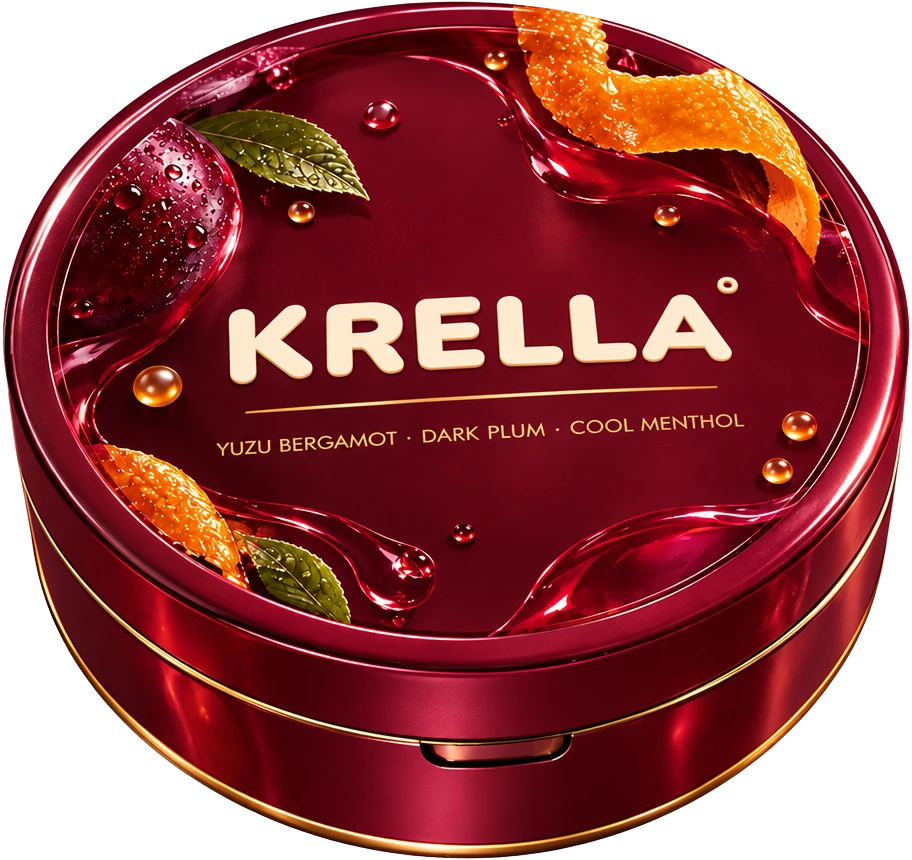
Krella is the first consumer venture of Hickson Endeavours: an ionic liquid botanical sachet built on beta-phenylethylamine (β-PEA, also written B-PEA) geranate.
Some things just belong together.
Bright hello
1Yuzu brightness and Earl Grey bergamot arrive first. Crisp, polished, and gone before they overstay.
Velvet middle
2Plum and violet settle in next. Deep without turning sweet, soft without disappearing.
Clean goodbye
3The fruit fades and cool takes the room. That simple finish is your cue to take it out.
Tuck it
Place it comfortably between your upper lip and gum.
Forget it
Let the flavor move while you get on with the moment.
Take the cue
When cool menthol is the last note standing, you're done.
Consumer products and companies built from what the inquiry teaches, made to be useful on their own merits in the places a life is actually lived. Krella, an ionic liquid botanical sachet, is the first.
For teams who carry genuine consequence, we read the substrate first: how much autonomic range remains, how quickly the system returns to baseline, and what the day is quietly costing. From there we design exposure and recovery with care, and we stay on, season after season, as stewards rather than visitors.
Homes, clinics, and institutions shaped so that the nervous system no longer has to pay so dearly to stay open. Light, warmth, acoustics, and the pace of a room all tell the body whether feeling is affordable, and we design those signals on purpose.
Work alongside governments, justice systems, and public health institutions, built on a plain observation: people are rarely the problem; conditions are. We close the distance between how a system assumes a person will behave and how a body under sustained load actually does.
Essays on how biology, development, and environment influence human behavior, and what those influences mean for self-understanding, institutions, and our relationship with the rest of life.
26 October 2026
A Two-Sided Account of Attenuation and Scope Disillusion, with Eight Propositions and Eight Testable Predictions
Read the essay21 October 2026
The Architecture of Self-Observation, Conditional Agency, and Cosmological Participation
Read the essay14 October 2026
Gradient Cosmology, Archetypal Navigation, and the Honest Differential
Read the essay