Abstract
Four billion years of self-preserving chemistry built a stress system designed to activate and then finish, and then grew a cortex that keeps it switched on indefinitely. This essay follows what happens next: how unresolved threat accumulates as allostatic load, how the brain turns down its own interoception to stay functional, and how a civilization raised inside that dampening learned to read it as health. At the center stands the clinician, shaped by a pipeline that reproduces the same dimming, then asked to measure everyone else's distance from a baseline no one in the room currently occupies.
Section outline
This essay draws on physiology that is not in dispute, including the stress axis, the autonomic nervous system, the vagus nerve, the default mode network, and the interoceptive pathway, and on experimental psychology and genetics where the findings are solid but some interpretations remain argued. Every mechanism named here has a published literature, and the references at the end exist so the reader can check. It is not medical advice, and nothing in it is a reason to start, stop, or change any treatment; those decisions belong with qualified clinicians. It is also not an accusation. Not of clinicians, who were trained inside the same condition they are asked to treat. Not of believers, whose maps are examined here as structure, not mocked as error; the essay states outright that the wisdom was real and the debt is not in dispute. Not of skeptics, who run the same equipment as everyone else. The claim is structural: a stress system built to activate and then resolve is being activated without resolution, across an entire species, and structure indicts no one.
The premise is narrow and testable. A body that never finishes its stress response will eventually stop reporting it, and the essay walks the evidence for that claim in order: from the first membrane, through the cortex that learned to rehearse its own death, through terror management, allostatic load, and interoceptive downregulation, to the training pipeline that reproduces the dimming in every new clinician. The closing sections make the opposite case on equally specific grounds: the pathway does not atrophy, accuracy improves with practice, and vagal tone responds within a single session. Abstract Four billion years of self-preserving chemistry produced a mind that can measure the edge of the observable universe, and cannot measure the state from which it measures. That same mind struggles to tell a difficult season from a nervous system in genuine distress, a confusion older than medicine, older than language, older than the skull that contains it, and it reaches its purest expression in the one profession built to close it. This essay walks the evidence from the first self-preserving chemistry to the modern diagnostic office, explaining each mechanism in full as it goes. It grants human life its full strength first: the loves, the convictions, the nations, the gods. Then it lets the measuring sciences report, one discipline at a time, what they have found underneath all of it. What surfaces is a single, species-wide condition that this essay names carefully: a civilization of nervous systems living at a measurable remove from their own internal signals, narrating their days from inside physiological states they cannot see, divided between those granted the structural luck of enough safety and education to look up, and those confined, by circumstance far more than by choice, to flat and inherited maps of reality. At the center of the condition stands its perfect emblem: the clinician, trained to guide patients back into contact with their own bodies by a training process that first walks the clinician out of contact with theirs. Every judgment a human renders is issued from inside a physiological state. The dilemma belongs to no profession; the profession merely holds it up to the light. It lives in the design of the system rather than in anyone's character, which, mercifully, is the hopeful part: designs can be redrawn.
I. The First Decision
Four billion years ago, in water no instrument will ever sample, chemistry crossed a threshold: a membrane formed, and with it the first distinction between inside and outside. Everything alive today descends from that distinction. The cell holding its salinity steady against the sea, the bacterium swimming toward glucose and away from acid, the redwood pumping water a hundred meters against gravity; each keeps the same founding commandment: hold the interior, guard the boundary, persist. Biologists call this homeostasis, the continuous work of keeping a body's internal conditions, its temperature, chemistry, and energy, within the narrow ranges that sustain life. It is the oldest unbroken behavior on Earth, a command that has never once been relinquished. Before there were neurons, there was regulation; before there was experience, there was preference, toward whatever sustains the loop, away from whatever breaks it. Every later structure, from the first nerve nets to the human cortex, was built in service of that commandment and answers to it still. The body reading these words is keeping it at this moment, without being asked, as it has, without interruption, since before the reader had a name.
What follows is the account of how that ancient housekeeping grew equipment elaborate enough to notice itself, and what the noticing cost.
II. The Stress System That Outlived Every Redesign
Once evolution built a working emergency system, it kept it. The stress physiology of a modern human runs on hardware recognizable across half a billion years of vertebrate life. When a threat registers, the amygdala, a small alarm structure deep in the brain, signals the hypothalamus, which signals the pituitary gland, which signals the adrenal glands above the kidneys, and within seconds cortisol and adrenaline flood the bloodstream. This same chemical cascade fires in fish, in lizards, in sparrows, and in the reader. Endocrinologists can trace its family resemblance down the entire tree of life. Nature, having found a design that worked, declined to reinvent it. When a threat registers, the sympathetic branch of the autonomic nervous system, the branch that mobilizes the body for action, musters the whole organism as a single instrument: the heart accelerates, the airways dilate, the liver releases stored glucose, digestion and immune maintenance pause, pain thresholds rise, and attention narrows to a point. The creature becomes, temporarily, exactly one thing, an answer to the problem in front of it.
When the problem passes, the system performs its second, quieter miracle: it finishes. The parasympathetic branch, the branch responsible for rest and recovery, engages through the vagus nerve, the great signaling cable running from the brainstem through the heart, lungs, and gut. The mobilized energy discharges through exertion, trembling, and deep rest, and the animal settles back to baseline. A deer that survives a wolf returns to grazing within the hour, fully. The event lived in tissue, and ended in tissue. Across nearly the whole tenure of life on Earth, stress was acute, embodied, and complete. One detail carries everything ahead: this system was built for completion. It expects an ending, and for four billion years the world reliably supplied one.
III. The Cortex That Learned Time
The human lineage arrives late enough to qualify as a rumor. The genus Homo is perhaps two and a half million years old; Homo sapiens perhaps three hundred thousand. Measured against the four-billion-year record, the entire human story occupies the final fraction of a second.
Within that fraction, one extraordinary event unfolded. Between roughly two million and two hundred thousand years ago, the hominid brain nearly tripled in volume, among the fastest organ expansions in the fossil record, and the growth concentrated in the prefrontal cortex, the thin rind of tissue behind the forehead. This region delivered working memory, the ability to hold absent things in mind; temporal projection, the ability to rehearse futures that have never occurred; symbolic language, the binding of sound and mark to object and idea; and metacognition, the looping of awareness back upon itself.
Evolution has no intentions; it trades, blindly and at scale. A cortex that can rehearse the future will, sooner or later, rehearse its own absence from it. The wiring that allowed a tracker to read a bent twig allowed a primate, sitting by a fire, to read the full arc of its own existence through to its conclusion. For the first time in the history of the biosphere, a creature organized around self-preservation came into permanent possession of the knowledge that preservation fails. Every animal runs from death. One animal narrates it in advance, to itself, quietly, at three in the morning. The collision that followed was structural. The oldest equipment on Earth, built to answer threat and then finish, was now yoked to the newest equipment, which generates threat endlessly: symbolically, chronically, on schedule, without a predator in sight. The collision also explains the ego's origin. A brain that plans by rehearsal needs a character to move through its rehearsals, a body with a name, so that consequences can be assigned to someone. Because the lineages that planned best survived best, that placeholder grew elaborate: a history, a social standing, a set of values, a story with a center. The feeling of being someone is the face of that model. Neuroanatomy can point at it directly. When people think about themselves, imaging studies consistently show activation in a band of structures along the midline of the cortex: the medial prefrontal cortex and the posterior cingulate cortex, the central hubs of what researchers call the default mode network, the circuitry most active whenever a mind is at rest and turned toward itself. This network is the brain's self-referential system, and this essay will return to it repeatedly. It is the seat of the inner narrator, the dashboard the animal consults, and it feels like the driver.
IV. The Vivid Interior
Before the measuring sciences report on this species, the species' own testimony deserves full entry into the record. A human being is a small animal navigating an ecosystem so large it has weather systems and interest rates, and yet the interior of that animal blazes. Humans hold opinions they will defend at dinner tables and die for at borders. They fall in love with particular faces and build forty-year architectures around the falling. They raise flags, keep covenants, carry grudges across generations, weep at songs written by strangers, and wake before dawn to address beings no instrument has ever detected, with complete sincerity, and often with effects they can feel in their chests. The sense of being someone, a named, continuous, morally significant someone standing at the center of a story that matters, is the most vivid datum in every human life, vivid enough that whole civilizations have been organized as cathedrals to it. All of this is real as experience. None of it registers on the measuring instruments as anything but physiology. Both statements are true, and the distance between them is where the species lives.
Between the two facts, the small animal in the massive ecosystem on one side and the blinding significance of the story it tells itself on the other, a distance opens, and psychology has named the pronounced forms of that distance. Dissociation is the clinical term: a measurable loosening of the normal coupling between the brain's self-narrating networks, centered on the default mode network, and its feeling networks, centered on the insula and the limbic system. The story of the body continues with the volume of the body turned down. Most people who live with its milder forms have never heard its name. Depersonalization, feeling detached from one's own body, and derealization, feeling detached from one's surroundings, rank among the most common experiences in psychiatry and among the least recognized, precisely because the condition disguises itself as ordinary life. The evolutionary record suggests something wider: a species permanently stretched between what it biologically is and what it believes itself to be keeps a foot on that brake more or less, continuously. The gap between the animal and the story must be minded by someone, every minute of every day. In nearly every member of the species, that minding runs silently, below awareness, and is experienced as ordinary consciousness.
V. The Buffer
A nervous system cannot run an open mortality channel and still find breakfast. The species answered the way biology always answers an unsolvable load: it built around it. Across tens of thousands of years, human groups raised shared symbolic worlds: myth, ritual, ancestor, tribe, nation, rank. The experimental literature on terror management theory, the framework Ernest Becker proposed in The Denial of Death in 1973 and psychologists Jeff Greenberg, Tom Pyszczynski, and Sheldon Solomon then tested across hundreds of studies in dozens of cultures, documents what these structures do. Remind a person of death, and attachment to their cultural worldview strengthens; generosity toward insiders rises; suspicion of outsiders sharpens; self-esteem begins to track standing within the shared story. To belong to something larger than one lifespan is to borrow permanence.
The causal chain underneath runs as follows. A buffer only buffers if it is believed, and a myth held loosely anesthetizes nothing, so the same equipment that needed the story also manufactured the feeling of certainty about it. Conviction is the anesthetic working, delivered as the sensation of truth. The contents were installed early. A child absorbs the story of the house it is born into, the language, the flag, the faith, the sanctioned enemies, because accepting the local story predicted safety, and the equipment always chooses safety. Decades later, the adult experiences that inheritance as identity. And because a story proves its permanence-giving power comparatively, ours endures and theirs fades, the identical mechanism that generates warmth toward the in-group generates suspicion of the out-group. Love of tribe and fear of stranger are one bell, struck on both of its sides.
Two findings now describe the ground beneath all of it. Both arrived as byproducts of research aimed elsewhere, and both land with the flat, unanswerable quality that only byproducts have.
The first belongs to population genetics. Roughly eighty-five percent of all human genetic variation resides within any single local population. The remainder drifts gradually across geography in continuous gradients, called clines, rather than in discrete blocks. Two members of the same village can differ genetically more than either differs from a stranger on another continent. The categories the species uses to divide itself, the ones it has fought its bloodiest wars over, correspond to a thin and superficial layer of biology. The boundaries defended most fiercely in human history sit on the shallowest stratum of the genome.
The second belongs to earth systems science. Carbon isotopes, watershed chemistry, aerosol currents, and viral lineages all trace a single closed metabolism. Carbon released on one continent alters the isotopic signature of soil on another. A drought in one hemisphere reprices bread in the next within the year. A virus crosses every border ever drawn without acknowledging one. The biosphere runs as an organism-scale loop; the lines on political maps govern paperwork rather than physics. The canopy of stories still holds, and it still does honest work; a person needs cover from an open sky. The ground it stands on is slope and flow, all the way down.
VI. The Flat Maps
For most of the species' existence, that canopy of stories was the only map anyone owned, and it deserves its due. The great narratives carried real wisdom, ordered real communities, and held real terror at bay. The figure of Jesus of Nazareth anchored the most successful of them, a story strong enough to organize two thousand years of architecture, music, law, and morning prayer. On all of this, the evidence is content to agree: the wisdom was real, the order was real, the comfort was real, and the debt civilization owes these narratives is not in dispute. The record must then add one structural observation, delivered without anger. As systems of belief, an inherited cosmology and a flat Earth occupy the same plane: closed loops that ask for loyalty rather than evidence, that cannot be dismantled by new information, that persist through belonging rather than verification. They are flat in depth; there is no drilling down into them, only repetition across. A cathedral differs from a flat-Earth forum in age, in beauty, in social reach, in nearly every property a culture can measure, save the one this essay is built to examine: how a belief behaves when evidence arrives at its door. On that property, the two are indistinguishable.
Against this horizontal plane, the scientific tradition runs vertically, and its defining trait is the one least understood by the public that enjoys its fruits: science is a craft calibrated to its own ignorance. Modern cosmology has surveyed the universe and found that everything humanity has ever seen, touched, weighed, or been made of, every star, every element, every human body, accounts for roughly five percent of the total mass-energy of existence. The remaining ninety-five percent is filed under two honest placeholders, dark matter and dark energy, which translate plainly: measured, undeniable, and unidentified. The two pillars of fundamental physics, general relativity and quantum mechanics, each perform flawlessly in their own domains and refuse, mathematically, to be reconciled; both break at the center of a black hole, and at the first instant of time. The people working this frontier do not possess the truth. They hold the most precisely surveyed map of the unknown ever drawn, and they can show you exactly where the map ends.
Perhaps one percent of the species lives inside that vertical frame. The rest inhabit the twenty-first century's outputs, the smartphones, the vaccines, the shipping lanes, while remaining locked out of the method that produced them. What matters about the lock is less its existence than its key, and the key is almost never in the hand of the person inside. Vertical thought requires what this essay calls headroom: the spare cognitive capacity that comes from decades of training, material security, and a nervous system freed from survival anxiety long enough to look up. A mind spending itself on rent, safety, and the next week cannot afford cosmology. The inherited myth, in that condition, works as a life jacket, and asking a drowning person to analyze the water is a cruelty dressed as education. The believer in Nazareth, the believer in the flat disk, and the skeptic smiling at both are doing the same thing for the same reason: each mind gripping whichever map its circumstances could afford. Most humans did not choose their maps. Their maps were assigned by fortune, the way height and hometown are assigned. Neuroscience supplies the machinery under the metaphor. Belief revision is expensive tissue work: it runs on the prefrontal cortex, the most metabolically demanding, most recently built, and most easily starved region in the skull. Under sustained threat, the brain triages. Blood flow and glucose shift toward the amygdala and the older alarm circuits, and the prefrontal networks responsible for testing a belief against new evidence dim first. The anterior cingulate cortex, which produces the brain's error signal, the small internal flag that rises when a map has failed to match the territory, gets damped, because a brain under siege cannot afford to rebuild its maps mid-battle; it can only defend them. Researchers Sendhil Mullainathan, Eldar Shafir, and Anandi Mani watched this happen in real time: in a 2013 study published in Science, sugarcane farmers in India scored measurably lower on cognitive testing in the lean weeks before harvest than in the flush weeks after it, the same farmers, the same brains, a swing comparable to a lost night of sleep, produced by nothing but the metabolic cost of worry. Attention, under load, does not merely prefer the flat map. It loses the apparatus required to question it. This is the first face of the condition this essay tracks: an entire species, minus a fraction, living by flat maps, attention fused to stories that cannot be questioned, in lives that leave no room to question them. The clinical literature reserves the word dissociation for individuals, for the person whose self-narrating networks have visibly decoupled from their feeling ones. But the decoupling does not ask the literature's permission. Applied honestly at scale, the word describes a civilization.
VII. The Chronic Environment
For nearly the whole of human existence, stress arrived in the shape the old equipment expected: physical, local, and brief. Then, in a biological blink, the environment transformed. Agriculture fixed populations in place and invented the future as a source of worry. Industrialization finished the abstraction. From the stress system's point of view, the modern load is a strange sight. A mortgage activates the hypothalamic-pituitary-adrenal axis, the same chemical cascade built for predators. A quarterly review activates it. An unanswered message at midnight activates it. None of these can be outrun, outfought, or, the critical failure, finished. The oldest system on Earth now answers symbolic danger on a loop measured in decades, mustering without discharge, bracing without arrival. Peter Sterling, the physiologist who coined the term allostasis, and Bruce McEwen, the neuroendocrinologist who spent decades documenting its toll, gave the accumulated cost its name: allostatic load, the wear that accrues when a system engineered for sprints is entered, indefinitely, in a marathon. Its signatures are concrete and measurable: elevated baseline cortisol, flattened daily hormone rhythms, chronic low-grade inflammation, altered vagal tone, elevated blood pressure, broken sleep architecture. These signatures appear, in measurable degree, across a large share of the species' current adult population.
There is one more property of the modern load worth naming, because it hides in plain sight: it arrives gift-wrapped. Every object in a contemporary life reaches the hand already finished, the phone, the blister pack, the meal, its entire history compressed into a price. The smartphone began in artisanal cobalt pits in the Democratic Republic of Congo, in the hands of people with no headroom to spare. The medication traveled a cold chain of precursor chemistry, policed maritime corridors, and sterile synthesis nodes before it reached a kitchen counter. The dinner crossed a grid of container ships and distribution algorithms synchronized to within hours. None of this is hidden. It is simply never asked after. The ease of the arrival is subsidized by a vast, unseen machinery of extraction and coordination, an industrial nervous system spanning the planet and touching millions of lives, and the flatness of the transaction is the interface working as designed: a good interface shows no seams. This is why a single question carries such unusual leverage. To ask of any object in the hand, how did this arrive to me, is to force one vertical act out of a horizontal life, and the answer runs downward, every time, through geology and labor and weather, into the same ground this essay has been standing on since the first membrane.
Under sustained load, the brain makes an adjustment that is elegant, lawful, and consequential. It turns down its own hearing. The technical term is interoceptive downregulation. Interoception is the flow of sensation from the body's interior, heartbeat and breath and gut, the visceral account of how the animal is actually faring, carried largely through the vagus nerve and assembled in the insular cortex, the region the neuroanatomist A. D. Craig spent a career mapping as the seat of the felt body. When the interior becomes a chronically uncomfortable place, the cortex thins its subscription to that channel and reroutes processing to the executive networks: planning, analyzing, performing. The adaptation preserves function. It also produces a person who can live for years slightly out of earshot of their own body, and who comes, in time, to experience the distance as personality. The dimming happens inside the nervous system itself. The body's signals still fire and still ascend; the brain turns their volume down at the point of assembly, dampening the signals of the very body it inhabits. In most modern adults, the vivid interior runs on that dampened feed. The clinical term for pronounced versions of this is dissociation. The rest of the population calls it Tuesday.
VIII. The Silent Majority Within
The dimming of inner hearing is one tributary of a far larger fact: the conscious self has access to almost none of the organ that generates it.
By any accounting, the overwhelming majority of neural work never crosses into awareness. The numbers carry the weight of it. Information-theoretic estimates, assembled most accessibly in Tor Nørretranders's The User Illusion, put the conscious channel at roughly forty to sixty bits per second, a keyhole, while the whole nervous system processes on the order of eleven million. Consciousness, in other words, operates on roughly one two-hundred-thousandth of the information the organism processes. Perception, prediction, memory consolidation, emotional appraisal: all of it runs continuously in regions that report only their conclusions, never their labor. The experimental demonstrations border on the absurd. Patients with blindsight, the phenomenon Lawrence Weiskrantz spent decades documenting, their primary visual cortex destroyed, insist they see nothing, and then reach accurately for objects they swear are invisible; the visual system still guides the hand while the self-referential network sincerely reports the room as dark. In split-brain patients, whose hemispheres have been surgically separated, an action ordered by the right hemisphere is instantly and fluently explained by the left hemisphere's interpreter, the module Michael Gazzaniga identified in his split-brain research, which invents a confident reason for a decision it never made. In the choice-blindness studies of Petter Johansson and Lars Hall, people handed the photograph they just rejected proceed to defend it as the one they chose, constructing warm preferences on the spot for a decision that belonged to someone else entirely. The reckoning is humbling in a specific way. The felt narrator, the one with the opinions and the convictions, corresponds, in the scanner's accounting, to the default mode network working in concert with the left-hemisphere interpreter: a self-narrating system briefed after the fact, issuing its account of the day with total sincerity.
The confabulation has a reason, and the reason is stability. The self-model requires causal continuity: a life containing unexplained actions reads, to the equipment, as a broken story, and a broken story threatens the buffer that keeps mortality manageable. So coherence gets manufactured on demand, honestly felt, instantly produced. And when a belief is challenged, the amygdala answers the way it answers physical danger, because at the level of the wiring the challenge is physical. The belief is load-bearing, mortared into the same structure that regulates the body's alarm. People defend opinions the way they defend territory because, to the nervous system, opinions are territory, the ground the story stands on.
Under chronic load, the integration problem deepens structurally. Sustained cortisol exposure measurably weakens the connectivity between the prefrontal cortex and the limbic system, the bridge between the planning self and the feeling animal. Memories formed under threat fail to integrate. They are stored without the hippocampal timestamp, the contextual tag the hippocampus attaches to mark an experience as past, so they fire in the present tense, as fragments: a tightening chest at a tone of voice, a flood of shame at a stranger's expression, arriving with no narrative attached. Clinicians who work with trauma describe parts of the person that never joined the whole: responses that run on their own schedule, in their own dialect, outside the council of the systems that keep a person feeling like themselves.
Current thought in the field adds one more precision, and it concerns the moments when this buried material rises. Depleted states are the gate openings. Executive control is the most metabolically expensive operation the brain performs; the organ is two percent of the body's mass and spends roughly a fifth of its energy, much of it on the inhibitory work of the prefrontal networks. When exhaustion, stress, or the simple depletion of early morning drains that margin, inhibition fails first, and whatever the deeper systems have been holding floods the narrow channel of awareness. The character of what rises is decided by a separate and older question: whether the surroundings read as safe. The autonomic nervous system answers that question continuously and below awareness, a scanning that Stephen Porges's polyvagal theory calls neuroception, and its verdict gates what the unconscious delivers. In an unsafe room, among unsafe relationships, depletion admits the threat scripts: hypervigilance, ancestral alarm, the loops already described. In a safe one, the same opening admits something else entirely: memory consolidation, emotional processing, the clean arrivals of insight that the incubation research keeps recording. The laboratory finding underneath the difference is memory reconsolidation, the mechanism Karim Nader's experiments forced the field to accept: a retrieved memory becomes changeable before it is stored again. A stored threat memory can only be rewritten when it is reactivated under conditions of safety; safety is the solvent in which old material changes form. This is why the same exhausted brain spirals into its oldest suffering in one room and produces the clearest thought of its life in another. The state is identical. The setting is the variable.
These unintegrated parts do not wait quietly for integration; they steer. The argument picked at dinner, the stranger disliked on sight, the career chosen in perfect freedom, the conviction held with total certainty, the attraction, the recoil, the vote: each rises substantially from circuitry the self-model has never met, and each receives, afterward, a story. A state has no awareness of itself, but it holds full executive authority. It answers the emails, ends the relationship, abandons the project, signs the lease, and the narrative self records the day, afterward, as a series of considered decisions. The laboratory has watched this order of operations in miniature. In Benjamin Libet's classic experiments on voluntary movement, a characteristic rise in motor-cortex activity, the readiness potential, begins hundreds of milliseconds before the person reports any urge to move; in later work by John-Dylan Haynes and colleagues, researchers decoded which of two buttons a person would press from frontal and parietal activity seconds before the person felt the decision arrive, at rates above chance. The organism moves first; the narration follows. This is the ordinary sequence in every human skull, every day, in every courtroom and clinic and kitchen on Earth. A week authored by an unexamined state becomes a month of coping with what the week produced; the month becomes a life chapter; and the chapter becomes evidence for the story that caused it. Every life is co-authored at every hour by processes that fire out of concert with the self and answer to no one in it. The seep is total: into love, into politics, into medicine, into the writing of essays about the human condition.
IX. The Institution
At the turn of the twentieth century, industrial life was generating more chronic dysregulation than any prior era, and the species answered as it always does: it built an institution. The Flexner Report of 1910 standardized medical education around a mechanistic, laboratory-anchored model of the body, raising the scientific floor of an entire profession. Psychiatry and clinical psychology formalized alongside, at speed, for honorable reasons. There was a great deal of suffering, and very little time, and the new medicine genuinely worked, against infection, against injury, against a hundred previously fatal conditions. The framework carried one quiet assumption, invisible at the time: that the human being was best understood as the sum of its parts, and distress as a defect located in an individual, classifiable by symptom cluster, correctable by intervention aimed at the cluster. The Diagnostic and Statistical Manual of Mental Disorders, the DSM, codified the assumption into categories as its successive editions multiplied them. The insurance systems that followed made the categories the price of admission; no code, no reimbursement. The licensing boards made adherence the condition of practice.
None of this proceeded from cynicism. All of it was design, assembled quickly, under pressure, in good faith, with the best tools the moment could offer. The record should also show what the design could not see: it classified the alarm without ever asking what the alarm was about.
X. The Pipeline
The dilemma lives in the pipeline, in the road taken by every human being who staffs this institution.
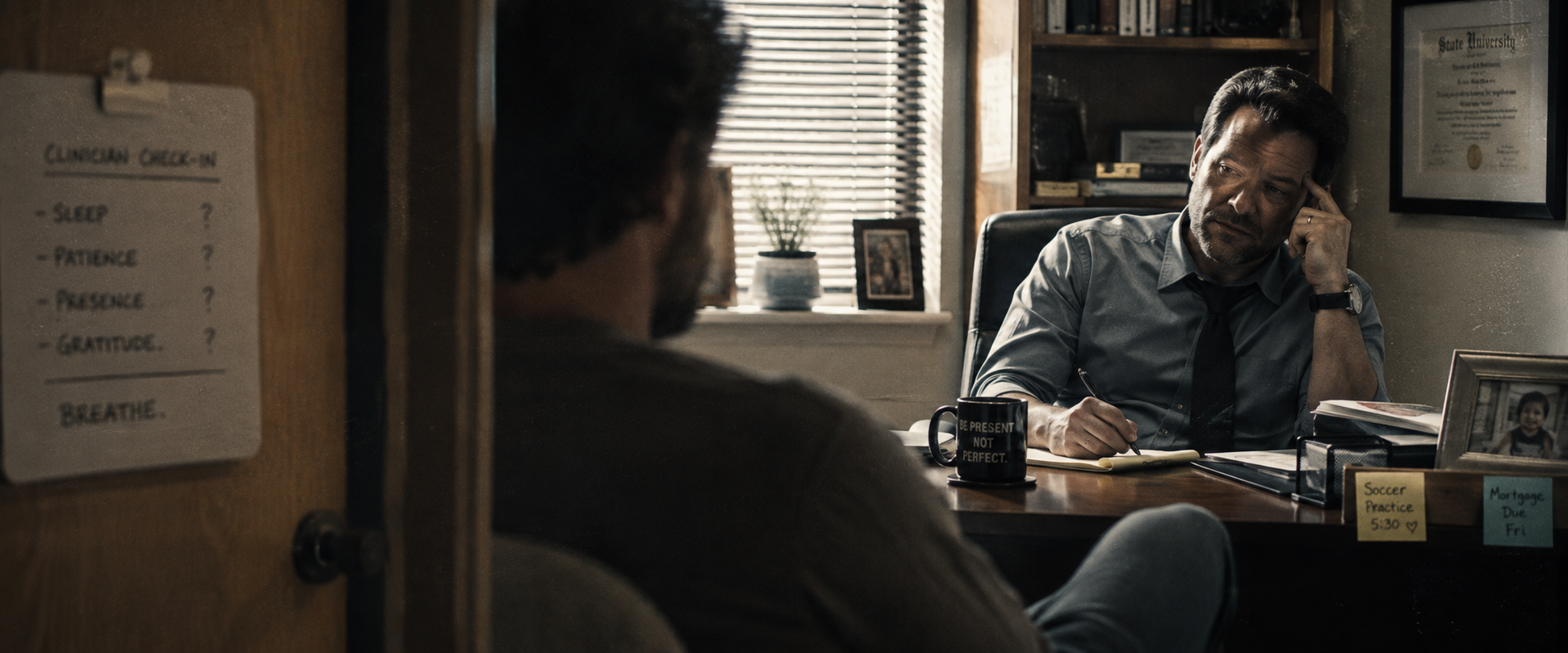
The training of a clinician runs roughly a decade. Examined physiologically, the decade reads like a controlled experiment in allostatic load: chronic sleep deprivation lasting years, sustained financial strain, near-continuous high-stakes evaluation, hierarchical pressure, immersion in the suffering of others. The trainee's nervous system answers the way every nervous system in this account has answered; the response is biology long before it is ever a choice. Interoception dims. The insula quiets. Processing migrates upward into the executive networks, among the differentials and taxonomies and codes. The trainee learns to translate the shaking of a hand into a Greek-derived term, to fit the structural panic of a displaced animal into an alphanumeric category, and, quietly, to hold their own interior at arm's length. The profession's own literature confirms the shape of this: medical trainees show elevated rates of burnout, emotional exhaustion, and depersonalization, the clinical vocabulary for the very same dimming. What the profession calls a condition in patients, it calls resilience in trainees, and selects for it at every gate.
What graduates at the far end is a genuine expert. The licensed clinician can match a presentation to a diagnostic category inside a thirty-minute window, a real, hard-won, humane skill. What also graduates is a nervous system trained by a decade of reinforcement to treat its own body as an appliance to be managed rather than a voice to be heard. This expert then sits down across from a patient whose chief complaint, beneath whatever vocabulary brought them in, is the same distance from the same voice.
The dilemma compresses into a single sentence: The diagnosed are doing the diagnosing.
Every one of us appraises another person's inner state from inside an inner state of our own, and the state we occupy feels like the world, like baseline, like health. When nearly everyone lives at some distance from their body's signal, that distance becomes invisible. The clinician is no exception. They measure the patient's estrangement with a gauge that was itself calibrated, over a decade of training, inside the same estrangement.
The institution built to restore the conversation between mind and body staffs itself through a process that muffles that conversation first. The clinician's license depends on protocols written by the consensus; their salary depends on codes issued by the framework; their standing depends on outcomes measured against a statistical norm that the entire population, under the same chronic load, is quietly failing to meet. The healer who pauses to ask whether a patient's despair might be a lawful response to the environment, whether the alarm might be accurate, steps outside the reimbursement structure, outside the protocol, outside the liability shield. The room itself forbids the deeper question. And the room was bolted to the floor decades before anyone now sitting in it was born.
XI. The Posture Of The Evidence
The claim that no human judgment is exempt from state, expert judgment included, does not rest on metaphor. It is among the most thoroughly replicated observations in the behavioral sciences, and the evidence arrives from courtrooms, laboratories, and pharmacies alike.
Begin with the people trained longest to be impartial. In a widely cited 2011 analysis by Shai Danziger and colleagues of Israeli parole boards, seasoned legal professionals ruling on matters of liberty, favorable decisions began near two-thirds after each food break and declined toward zero as each session wore on. The law did not change between morning and afternoon. The defendants did not change. What changed was the blood chemistry of the judges, and the rulings tracked it. Every judge involved would have sincerely reported that they were applying statutes.
The laboratory versions are gentler and no less damning. In Norbert Schwarz and Gerald Clore's classic experiments on mood and judgment, people who found a coin left by researchers, or who were simply interviewed on a sunny day, rated their entire lives as significantly more satisfying, and reported full confidence in the assessment. A lifetime, appraised through loose change and weather. Under sad mood, memory preferentially retrieves sad evidence; the state assembles its own case file, and the narrative self mistakes the file for the facts. In Molly Crockett's studies at Oxford, acutely lowering a volunteer's serotonin in a controlled setting shifted moral judgment measurably: unfairness became less tolerable, punishment more appealing. The sense of right and wrong, the thing people hold most certain, rides on transmitter availability like everything else. The strongest demonstration is the one millions of people carry in their own bodies. A person wakes in a state that narrates hopelessness with total conviction: the career is dead, the future is closed, the suffering is profound and necessary. They take a molecule, and by afternoon they inhabit a different metaphysics. The world did not change. The facts did not change. The witness changed. Every such morning is a controlled experiment with an audience of one, proving that the deepest convictions of a life can be functions of baseline chemistry, and that the chemistry, mercifully, can be worked with.
From these findings the keystone falls into place: a system cannot appraise itself from entirely within itself. Awareness of a state requires contrast, direct experience of a different state to measure against. The person who has only ever known the storm has no category for storm; they have a category for reality. This is why the first taste of genuine headroom arrives as a shock mixed with grief: the quiet recognition that one had been playing life on its hardest setting without knowing another setting existed. Predictive neuroscience, the framework Karl Friston formalized and Anil Seth carried to a wide audience, closes the loop from the other side. Perception itself is a controlled construction, the brain's best guess assembled from prior expectation and bodily signal. No one touches the world directly. The redness of red, the solidity of the table, the nearness of one's own thoughts: each is rendered inside the skull, privately, and the rendering is so seamless that the seam has never once shown. Everyone reads their own model of the world, and the model is written in chemistry. Sit with that for one honest moment, and the ground moves. The world a person has lived their whole life inside is, in the strictest technical sense, a private simulation, a faithful and useful one, shared with no one directly, checked against the outside only through the narrow channels of sense. The shock this delivers to an ordinary reader is the exact shock of the diagnosis itself: the isolation was always there. The finding merely gives it its name.
None of this stops at the clinic door. The profession's own journals document prescribing behavior drifting with fatigue across the day, burnout and depersonalization running at elevated rates through training, and judgment bending under the same loads that bend everyone else's. The expert is a state appraising states, equipped with better vocabulary and a license, and equipped with no exemption whatsoever. This is no accusation. It is the evidence, and the evidence includes everyone who has ever examined it.
Which is why the stance compresses, at last, into one image that no finding in this section contradicts: The clinician who believes they are above chemical intervention is like a wave that believes it is above water. Every healer who has ever said "I would never need that" was, in that exact moment, a state speaking about itself in the third person.
XII. The Converging Crafts
While the institution held its shape, the sciences kept moving, and their findings have arrived, from independent directions, at the same address.
In neuroimaging laboratories, researchers have scanned the brains of praying nuns, meditating monks, and volunteers in guided psychedelic sessions, work associated with Andrew Newberg, Judson Brewer, and Robin Carhart-Harris respectively, three traditions sharing almost nothing on the surface. Beneath the scanner, the same event recurred: the default mode network, the baseline circuitry Marcus Raichle's group at Washington University first identified, which maintains the continuous narrative of a separate, enduring self, went quiet in all three. What surfaced each time was a felt experience of unity, timelessness, and unboundedness, reported with striking consistency across traditions that had never met. The capacity the species has variously named God, enlightenment, and ego dissolution appears to live at a single neural address, reached whenever the self-construction work falls silent. The contemplative traditions, laboring without instruments, had been describing the same brain all along, the same state, rendered in different tongues.
In affective science, Lisa Feldman Barrett's theory of constructed emotion has driven a parallel reclassification. The predictive brain runs the body like a treasury, continuously forecasting metabolic demand and allocating glucose, oxygen, and attention in advance of need, a process called allostatic prediction. Fear and anger register, under this lens, as resource-allocation rulings issued before conscious awareness is consulted. The ancient moral taxonomy of feeling, the sorting of emotion into proper and improper, civilized and pathological, dissolves into physiology: a spectrum of regulated and dysregulated states in an animal managing energy under load. Feelings carry information about the body's budget; they were never verdicts on the soul. The pattern, viewed whole, is consistent to the point of monotony. Genomics resolves race into clines. Earth science resolves borders into loops. Neuroimaging resolves exclusive revelation into shared neural capacity. Affective science resolves moralized feeling into metabolism. Discipline after discipline, working independently, has converted the constructs the species used to steady itself into mechanisms, lawful, measurable, and shared by every human body on the planet. None of the crafts arrived with an argument. They arrived with measurements, and the measurements have, quietly, withdrawn the foundations from under nearly everything the vivid interior holds most dear. The crafts of truth and the crafts of coping now point at the same facts from opposite directions.
XIII. The Archetype
The species' own account of itself, and the instruments' account of the species, can now be laid side by side. A four-billion-year-old commandment to preserve the self grew a cortex capable of seeing that preservation ends. To endure the sight, the species wove a canopy of stories vivid enough to live entire lives beneath, maps so absorbing that the vast majority of the species, confined by fortune to flat versions of them, has never once been shown the open sky above. To endure the modern load, it turned down its own interoception. To treat the consequences, it built a healing institution whose training pipeline reproduces the dimming in every new healer, and then handed those healers the task of measuring everyone else's distance from a baseline that no one, including the measurers, currently occupies. The result is a civilization of nervous systems operating with attenuated interoceptive signals, tended by a profession trained under the same attenuation. What this means, in plain physiological terms, is worth stating exactly. The stress response is a two-phase sequence: activation, then resolution. Modern threats never end, so the first phase runs continuously while the second never arrives. The body compensates by dampening the interoceptive signal, reducing the felt sensation of a stress response that is still running underneath. The cortisol remains elevated, the muscle tension persists, the inflammatory markers register on any blood panel; what has changed is only the person's ability to feel any of it. Each member of this civilization therefore mistakes the absence of a felt alarm for the presence of health. The alarm was never answered and resolved, the way the system was built to resolve it. It was made imperceptible, and the distinction between those two outcomes is the entire dilemma. Civilization, viewed from sufficient altitude, is the sediment of human states: law is fear given a marble building, markets are hope and panic graphed in real time, borders are a territorial reflex surveyed and fenced. The species calls this deliberation; the record, read without sentiment, shows weather, all the way up.
Follow the causal chain the whole way down and the ego dissolves into engineering. Rehearsal required a protagonist, so the brain built one. The protagonist needed permanence, so the culture supplied a story. The story needed belief, so the equipment manufactured certainty. Certainty needed contrast, so the world divided into us and them. And beneath every step of the construction sat one animal, running four-billion-year-old works, trying to regulate its alarm. Nothing in the chain required a villain. Every link was a solution.
And here the essay's true subject finally steps out of the clinic and into the open. Stand back far enough, and the diagnostic room stops looking like a special case. A parent soothes a frightened child from inside their own unexamined fear. A friend dispenses counsel from inside their own unfinished grief. A leader steadies a nation from inside a state they have never once identified as a state. Every human being spends a lifetime in the healer's position, tending to others from the middle of weather they cannot see, and the clinician is simply the human condition with a license and a thirty-minute window. The blind healer is the species' most honest portrait of itself: not a failure of one profession, but the purest available likeness of what it means to be a creature that can see everything except the eye it sees with. This is where accuracy matters more than comfort. No one in this account failed. The clinician is the most honest product of the sequence, a person who entered the pipeline to reduce suffering and was shaped, lawfully, by everything the record describes. The believer is just as honest a product, and so is the patriot, and so is the skeptic, and so is the reader. Every human being in this story did exactly what four billion years of self-preservation built them to do with the equipment, the map, and the circumstances they were handed. Whatever blindness occupies the diagnostic room arrived by design. It belongs to the architecture, and the architecture predates everyone inside it.
And that is where the account turns toward the practical, because design is the one kind of problem a species can work with. Design holds still long enough to be mapped, and the mapping has already begun. Somatic therapies now train clinicians to inhabit their own physiology before attending to anyone else's. Interoception research is carrying the body's signal back into the diagnostic conversation. Neuroscience and the old contemplative disciplines are converging on the same address with different instruments, each confirming the other's report. Training programs are beginning, quietly, to treat the healer's own regulation as a clinical instrument rather than a personal luxury.
The research is also quietly reframing the unconscious itself. The vastness this essay has described as a liability, the eleven million bits per second running beneath awareness, is equally available as an ally. Studies of incubation, Ap Dijksterhuis's work on unconscious thought chief among them, find that complex decisions handed to the unconscious and left alone are frequently resolved better than those forced through the narrow conscious channel; the answer surfaces later, unforced, as intuition. Learning to work this way, to pose a clear question, to refuse the ego's demand to settle everything in real time, to let the deep computation run, is the beginning of a different kinship with the organ: the self-model as the one who poses the query, rather than the one that does the math.
And at the scale of a single life, the mapping is concrete. It looks like this: a person keeps a quiet log of their own states against the only two coordinates anyone can actually measure, time and circumstance. Which hours bring the fog. Which rooms bring the dread. Which inputs, which feeds, which foods, which voices, leave the system quieter in the hours that follow, and which leave it loud. Which mornings begin with the conviction that the suffering should be sat in, and what changes when the baseline is steadied first. Within weeks, the invisible weather becomes legible as pattern; within months, predictable as physics. The person acquires the discipline of non-engagement, the working knowledge that thoughts generated in a depleted state are weather, not wisdom, and the state loses its power to sign the day's decisions. This is what the map looks like when it finally reaches the scale where the dilemma lives: one nervous system, taking its own measure honestly, no longer taking dictation from its own weather.
And beyond the clinic, the deeper work is the widening of headroom itself, the stubborn, unglamorous project of giving every mind, not just the lucky one percent, the security and the contrast required to learn the single liberating fact: that one is a mind having a state, and never merely the state. The stress system was built for completion. Threat, mustering, discharge, rest: the arc is four billion years deep, and it still runs in every human body, underneath everything layered over it. The dilemma of the blind healer is real, and it is large, and it belongs to everyone. It is also, at bottom, a story about a species that learned to see itself before it ever learned to feel itself. The seeing arrived first; it is now, patiently, drawing the maps that lead back to the feeling. The work ahead is slower than the diagnosis and, thankfully, kinder than the label. It begins where the biology has been waiting all along: in the diagnostic room itself, with the one variable that room has never controlled, the nervous system of the person holding the gauge. A species that has learned to measure everything else has one instrument left to calibrate, and it has been sitting across from the patient the entire time. When that calibration comes, and the methods already exist, in clinics and laboratories and training programs now running, the oldest sequence in the record will do what it was built to do. Threat, mustering, discharge, rest. The machinery was never broken. It was only waiting to be read. That closing claim is literal, and the physiology underneath it is specific. The interoceptive pathway that carries the body's signal, running from the vagus nerve and the spinal afferents up to the insular cortex, does not atrophy under years of dampened use; it persists intact beneath the attenuation, which is why the attenuation was always a turning-down and never a loss. Interoceptive accuracy, measured clinically by tasks as simple as counting one's own heartbeat without taking a pulse, improves measurably with weeks of directed practice. Vagal tone, the working index of the parasympathetic branch that completes the stress sequence, responds to slow breathing within a single session. And the networks that decouple under chronic load are capable of re-coupling under sustained attention, because the synapses involved obey the same plasticity rule as every other synapse in the skull: what is repeatedly measured is strengthened, and what is never read goes quiet without ever dying. The completion circuitry required no repair. It required observation, and observation is a trainable act with a dose, a curve, and a measurable result.